Color Symbolism and Madness
In Whiplash, color goes far beyond mere costume — it is a core device that visually shows a character's inner state and the degree to which they have assimilated into the 'madness' toward perfection. Bright colors symbolize purity or immaturity; black and dark gray signify brutal skill, controlled power, and ultimately the state of having assimilated into madness — tracking Andrew Neiman's mental journey.
The Language of Color: The Visual Code of Perfectionism and Madness
Whiplash deals with the auditory medium of music, but its narrative tension is visually maximized through color. Color goes beyond mere costume — it functions as a visual code symbolizing the artistic level a character has reached, or the mental pressure they are enduring.
1. The Point of Planting: A Contrasting Beginning (White vs. Black)
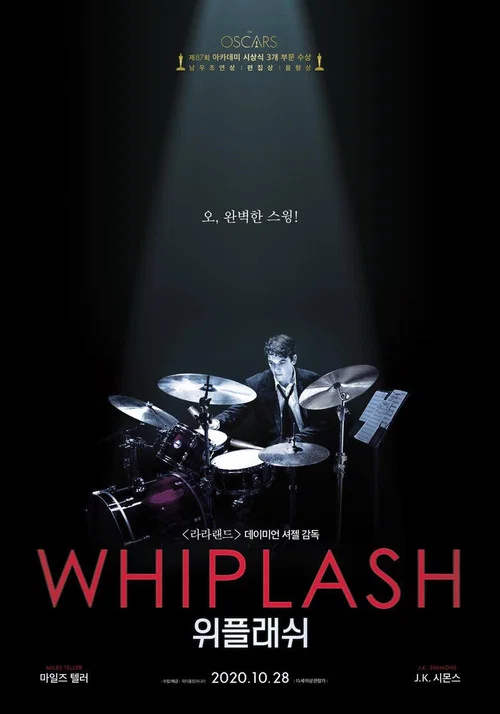
Early in the film, Andrew Neiman appears wearing a white T-shirt, constructing the image of a pure and talented freshman. By contrast, Terence Fletcher wears a black jacket and T-shirt — creating the dark, heavy atmosphere of "perfectionism" and "harshness." This contrast suggests that Andrew is still in a state of having only pure talent, and how vast a pressure Fletcher's world is for him.
This contrast repeats in the first ordeal Andrew undergoes in Fletcher's studio band. Members who cannot play properly appear in bright-colored clothes — symbolizing the immaturity of those who have not yet reached the realm of "perfection."
2. The Point of Payoff: The Penetration of Crimson and Darkness
The physical pain Andrew endures under Fletcher's brutal instruction is translated into color. One of the most symbolic scenes is when Andrew plunges his bleeding hands into ice water during practice. The moment the water turns crimson is a visual declaration that Andrew's talent is no longer sustained by pure passion alone, but is accompanied by pain and sacrifice like blood itself.
In scenes where band members compete, color divides them by rank. Ryan wears green, and Andrew a deep gray. These dark, deep tones are not mere costume — they are a psychological weight showing that they are competing fiercely toward the goal of "greatness."
3. The Foreshadowing List: The Colors of Assimilation and Completion
Color symbolism is also linked to Andrew's personal life. Relatives who belittle Andrew at the family dinner wear dark clothes — symbolizing the realistic and dark expectations that weigh on him. By contrast, in the moment Andrew takes the stage for the final performance, he removes his jacket and wears black, just like Fletcher. This signals that Andrew has completely assimilated into Fletcher's maddened worldview. He is no longer the owner of pure talent, but a reborn artistic warrior who shares that madness.
4. Why It Is the Core of the Work's Identity: The Acceptance of Madness
The final performance Andrew delivers goes beyond mere technical perfection. It is possible only because he has accepted Fletcher's philosophy — "you must pursue the greatest art even at the cost of your humanity." Andrew putting on black and sharing the stage with Fletcher does not mean he is rejecting Fletcher's teachings, but that he has accepted even their darkest parts as his own. This shift in color paradoxically shows that Andrew's growth was a process of "embracing madness."
Why It Matters
Color symbolism proves that Whiplash is not a simple music film but a psychological thriller exploring the mental limits of human beings. The process by which Andrew moves from white to black — passing through crimson — visually compresses how much sacrifice and madness artistic achievement demands. This is the device that conveys the film's core theme, 'the cost of perfection,' most intuitively and intensely to the audience.
Other 기타 dives4
- arrow_outward
Fletcher's Sociopathic Instinct
Terence Fletcher's character is interpreted as more than a harsh teacher — a figure with a cunning, sociopathic instinct who exploits the psychological vulnerabilities of others. He fixates solely on the value of 'perfect art,' completely excluding human empathy or ethical responsibility. Fletcher's behavior is less about educational method and more akin to 'hunting' his students.
- arrow_outward
The Real Performance and the Low-Budget Production Story
The dramatic immersion of Whiplash comes not from mere direction but from the genuine drum playing and physical dedication of lead actor Miles Teller. Even produced on a small budget, the vivid performance Teller delivered after three months of jazz drum intensive training is the core device that maximizes the film's realism — making audiences feel Andrew's pain and achievement with a vividness that goes beyond mere acting.
- arrow_outward
The Score-less, Transcendent Performance
Andrew's explosive score-less performance goes beyond a mere display of skill — it symbolizes the moment of 'awakening' in which he casts off the shackles of Fletcher's control and instruction to claim his artistic agency. This iconic scene showcases a raw artistic explosion of survival instinct and fury beyond technical perfection, maximizing the film's thematic consciousness.
Back to the title
Whiplash
14 deep dives in total