The Real Performance and the Low-Budget Production Story
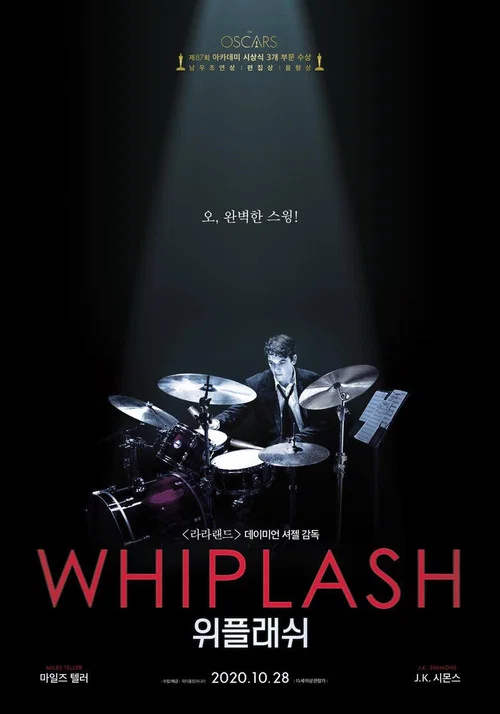
The dramatic immersion of Whiplash comes not from mere direction but from the genuine drum playing and physical dedication of lead actor Miles Teller. Even produced on a small budget, the vivid performance Teller delivered after three months of jazz drum intensive training is the core device that maximizes the film's realism — making audiences feel Andrew's pain and achievement with a vividness that goes beyond mere acting.
The Reality of Madness Created by Real Performance
Whiplash, as a music film, is a work where the authenticity of the performance scenes is directly tied to its lifeblood. One of the greatest behind-the-scenes stories is that Miles Teller actually played the drums himself — beyond mere acting. This was a decisive technical device that maximized the film's dramatic immersion.
1. The Actor's Dedication: Real Performance, Not Acting
Teller was virtually unknown at the time, yet devoted enormous effort to pull off the core jazz drumming of the film. He underwent four hours of jazz drumming intensive training per day for three months in preparation for the shoot, mastering the grip and style — reaching a level capable of performing the film's signature pieces "Whiplash" and "Caravan" to perfection.
This physical and technical dedication lent deep weight to every performance scene. The fact that even some scenes where Andrew bleeds in pain used Teller's own real blood gave audiences the basis to receive Andrew's agony as real suffering rather than a mere onscreen event.
2. The Paradox of Low Budget and Technical Mastery
Whiplash is known to have a relatively small production budget of $3,300,000. But because this film unfolded around the actor's real performance, it was able to raise its technical level while managing the budget efficiently.
Most noteworthy is that Teller's actual playing virtually matches the film's soundtrack. In some scenes, rather than overdubbing the soundtrack, the raw drum sound Teller produced on set was captured as-is. This conveyed to the audience a sense of being present on location and a raw energy, raising the film's realism to a new level.
3. The Matching of Performance and Sound: The Completion of Immersion
The fact that Teller's playing matches the soundtrack proves that the film is not simply "drama set against music" but "drama that deals with music itself." Audiences feel all of Andrew's successes and setbacks through the rhythm and impact coming from the actor's own fingertips — simultaneously imprinting how desperately physical and laborious Andrew's artistic achievement truly is.
Why It Matters
This production story connects perfectly with Whiplash's thematic consciousness. The film deals with the abstract and mad goal of 'perfection.' The process by which the actor exhausted his real skills and body to dissolve them into the performance conveys to the audience the physical and painful substance of the 'perfect art' Andrew pursues. Teller's dedicated playing is the most powerful evidence that Andrew's trials and achievements cannot be obtained by 'natural talent' alone — but are made through the painful process of 'blood and sweat.'
Other 비화 dives4
- arrow_outward
Fletcher's Sociopathic Instinct
Terence Fletcher's character is interpreted as more than a harsh teacher — a figure with a cunning, sociopathic instinct who exploits the psychological vulnerabilities of others. He fixates solely on the value of 'perfect art,' completely excluding human empathy or ethical responsibility. Fletcher's behavior is less about educational method and more akin to 'hunting' his students.
- arrow_outward
Color Symbolism and Madness
In Whiplash, color goes far beyond mere costume — it is a core device that visually shows a character's inner state and the degree to which they have assimilated into the 'madness' toward perfection. Bright colors symbolize purity or immaturity; black and dark gray signify brutal skill, controlled power, and ultimately the state of having assimilated into madness — tracking Andrew Neiman's mental journey.
- arrow_outward
The Score-less, Transcendent Performance
Andrew's explosive score-less performance goes beyond a mere display of skill — it symbolizes the moment of 'awakening' in which he casts off the shackles of Fletcher's control and instruction to claim his artistic agency. This iconic scene showcases a raw artistic explosion of survival instinct and fury beyond technical perfection, maximizing the film's thematic consciousness.
Back to the title
Whiplash
14 deep dives in total