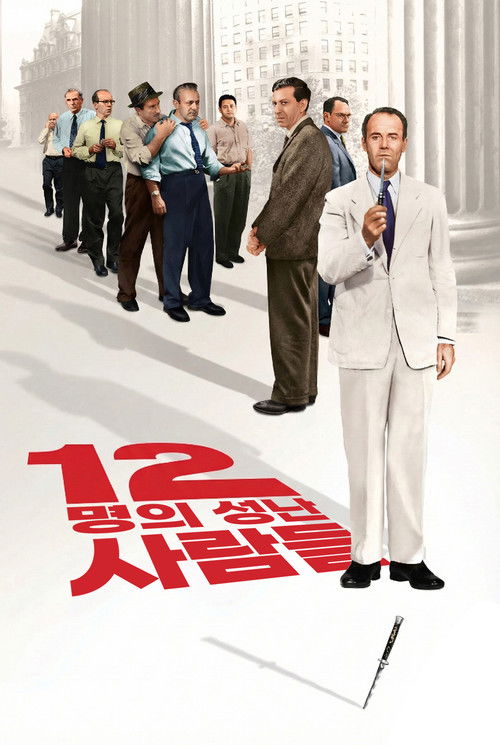
The Danger of Prejudice and Mob Psychology
The central theme of this film is to probe the absence of objective truth and the danger of mob psychology created by subjective human prejudice. The unanimous guilty verdict the jurors initially deliver shows how easily people succumb to 'collective certainty,' suppressing individual doubt. The film argues that truth is not an objective list of facts but a subjective process filtered through prejudice — and that breaking through this filter via 'reasonable doubt' is the beginning of justice.
The Filter of Prejudice: Human Subjectivity Obscuring the Truth
12 Angry Men is more than a courtroom drama about a murder trial — it is a psychological play that probes how subjective and fragile human judgment can be. Its deepest theme is the danger of 'prejudice and mob psychology.' Each juror approaches the case carrying their own professional background, social experience, and personal prejudice, and these individual filters combine to form a single massive 'collective certainty.'
1. The Danger of Collective Certainty (Groupthink)
In the film's opening, the sight of eleven jurors unanimously calling for a guilty verdict is a textbook example of group psychology. Beneath the shared belief that the evidence is airtight, they are reluctant to raise individual doubts or point out logical flaws. This mirrors the phenomenon whereby the premise that 'the majority must be right' suppresses individual critical thinking. The jurors resort freely to hate speech and snap judgments that degrade the quality of discussion — these become the greatest obstacles to truth.
2. Logical Errors Produced by Prejudice
Each juror's background is the foundation of their prejudice. The film meticulously shows how these prejudices produce logical errors.
- Class Prejudice (Juror 10): Juror 10 unleashes hateful language, characterizing the defendant as 'inherently violent' simply because he comes from the slums or is of immigrant background. This prejudice has nothing to do with the evidence. His remarks are met with cold indifference by the other jurors, ultimately leading to his isolation from the logical debate.
- Projection of Personal Emotion (Juror 3): Juror 3 projects the private anguish of his estrangement from his son onto the verdict. His argument for guilt is amplified not by legal facts but by his own anger and resentment. This kind of unresolved personal emotion is the most powerful obstacle to impartial judgment.
- Professional Limitations and Bias (Jurors 2 & 4): Both Juror 2 and Juror 4 work in finance. They possess logical minds, yet this very quality reveals its own limitation — a certain inflexibility. The fact that even they can miss physical evidence such as the glasses impression mark symbolizes that no matter how rational one's mode of thinking, no one can escape human cognitive limits and prejudice.
3. Dismantling Prejudice Through 'Reasonable Doubt'
True justice does not lie in 'discovering' objective truth, but in securing a space of doubt through the legal concept of 'reasonable doubt.' Juror 8's role goes beyond merely presenting facts — his goal is to make each juror question the certainties and prejudices they hold.
Every doubt he raises (e.g., the origin of the murder weapon, contradictions in testimony) remains in the realm of possibility — 'this could be wrong.' This process forces the jurors to realize how fragile the foundations of their certainty truly were. In the end, the conclusion the jury reaches is not the declarative statement 'the boy is innocent,' but the most careful and legally rigorous conclusion: 'based on the evidence presented, the possibility of innocence cannot be excluded.'
This film delivers to us the fundamental message that truth is not absolute, and that human judgment must always pass through the filter of prejudice — an insight that is timeless.
Why It Matters
What elevates this work beyond a simple legal thriller to the status of a masterpiece is precisely that it does not focus on whether the case's truth is revealed. Instead, it explores the process itself — 'how does one approach the truth?' The jurors' debate is a microcosm of the human psyche, and the prejudice, emotional outbursts, and logical flaws exposed along the way pose deep ethical questions to the audience. Through 'reasonable doubt,' the film leads to the philosophical conclusion that human beings cannot know absolute truth — and that this is the highest form of justice. This is the core engine that has kept the film alive as a classic across generations.
Other Reading dives2
- arrow_outward
The Separation of Truth and Evidence
The deepest subject of 12 Angry Men is the separation of 'Truth' from 'Evidence.' Rather than clearly establishing whether the boy is guilty, the film offers the legal conclusion that fragmentary pieces of evidence collected and interpreted by human beings can never yield absolute certainty. The process by which the jurors uncover logical flaws in the evidence is a philosophical inquiry showing that truth is not handed down from outside, but must be constructed through the process of reasonable doubt.
- arrow_outward
The Legal Weight of Reasonable Doubt
The film's core theme, 'Reasonable Doubt,' is not merely emotional uncertainty — it is a legal condition that arises when all presented evidence and testimony are insufficient to prove guilt with certainty. The film impresses upon the audience the principle that, no matter how compelling the evidence assembled, if 'certainty' is absent, the extreme punishment of death cannot be imposed — arguing that preserving reasonable doubt through legal procedure, rather than uncovering the truth, is the central process of justice.

Back to the title
12 Angry Men
16 deep dives in total