Nostalgia and the Emotion of Longing
At the heart of Cinema Paradiso lies the philosophical theme of 'the preservation of memory,' beyond simple nostalgia. The ruined theater and the reels of film Totò receives from Alfredo embody the impulse to hold on to pure moments that resist the passage of time — crystallized into the most beautiful form.
The Film of Memory: On the Edge of Preservation and Loss
In Cinema Paradiso, 'nostalgia' is given concrete form through a physical medium — 'film' — far beyond simple reminiscence. The film captures the emotional afterimage of feelings that do not change with time, and that is the very core force that shapes protagonist Totò's identity.
1. Stolen, Gifted, and Preserved: Memory
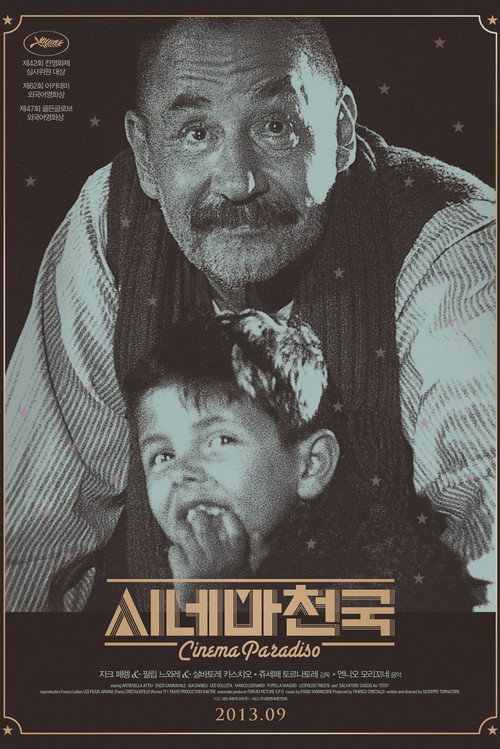
For young Totò, cinema was everyday life itself, and the movie house was a sanctuary. His act of secretly peering at the 'kiss scenes' that the authoritative Alfredo screens expresses his longing for a forbidden beauty. Rather than stopping him, Alfredo gifts him that very piece of film — and this act itself becomes the decisive catalyst that nurtures Totò's artistic love. Memory, in short, is completed through the process of stealing, receiving, and sharing.
2. Thirty Years Later: The Meaning of the Final Edit
After time has passed and Totò has left his hometown to become a successful director in Rome, the last bequest he encounters is the 'kiss reel' that Alfredo edited. This film is assembled from countless fragments of love and precious moments cut away by the external force of the priest's censorship. The scene in which Totò weeps watching this unending stream of kisses is the moment in which every happiness and loss he has experienced, and every trace Alfredo left in his life, is compressed and savored all at once. This shows the process by which all moments of the past are sublimated into 'art that must be preserved.'
The Ruined Theater: The Aesthetics of Time and Loss
The 'Cinema Paradiso' that forms the film's backdrop is not merely a location; it is a grand stage symbolizing the flow of time and the transience of human life. The theater Totò faces after thirty years is a ruin slated for demolition. This ruin signifies two losses simultaneously.
- Physical loss: The decline of the movie house itself as a space — disappearing in the face of war and the changes of the era (television, video).
- Emotional loss: The personal decline of Totò's lost pure childhood, and the 'missed opportunity' of his relationship with Elena.
In particular, when Alfredo throws himself into the crisis of the theater fire but is injured, and Totò takes his place in rebuilding the cinema — this shows just how fragile and precarious 'memory' is. That Totò personally contributes to the reconstruction in order to preserve it means he is not merely recalling the past but reconstituting it as part of his present life.
A Crossed Meeting: The Tragic Completion of Longing
The reunion of Totò and Elena is less a 'chance to meet again' than a 'confirmation of memory.' Elena speaks of the past and confesses that when Totò went to the cinema to find her, their timing was off — and Alfredo had concealed that fact — and so they could not meet. This confession makes Totò realize that the longing for a 'fateful meeting' he has carried for so long was in fact thwarted by the supremely mundane reality of misunderstanding and mistiming. It is the tragic completion of the insight that even the most beautiful memory of love can be rendered powerless by external intervention or the passage of time.
The weight of this 'missed meeting' connects to the feelings Totò harbors toward Alfredo. Having returned after receiving Alfredo's death notice, Totò realizes that all the precious connections he encountered in his life were blocked by the barrier of 'time and distance' — and sinks into deep regret.
Why It Matters
In this film, 'nostalgia and longing' are not a mere sentimental device — they are the existential core of the work. Every emotional pain and growth Totò experiences is driven by the desire to recapture 'the perfect moments of the past.' This is not a backward-looking film; it is a forward-facing reflection on why those moments matter.
Other 기타 dives6
- arrow_outward
The Film's Cultural Impact
Cinema Paradiso is celebrated not merely as a commercially successful film but as a work that contributed to redefining the identity and artistic value of Italian cinema in an era of decline — making it profoundly significant in cultural history. Jury Grand Prize at Cannes, Golden Globe, Academy Award, BAFTA: it swept the global film circuit.
- arrow_outward
Time and a Fateful Reunion
Totò and Elena's reunion in Cinema Paradiso transcends simple romance — it is a psychological journey through the great current of 'time' to unearth truths and misunderstandings buried beneath thirty years. The two people who face each other are not reconciling a romance; they are reckoning with the past.
- arrow_outward
Film Censorship and the Suppression of Art
In Cinema Paradiso, 'censorship' transcends a mere plot constraint — it is the most powerful external force threatening the very 'memory' that Totò and Alfredo have guarded, their pure artistic experience. This essay tracks how censorship recurs throughout the film, and how in the end it is transformed into the most beautiful form.
Back to the title
Cinema Paradiso
13 deep dives in total