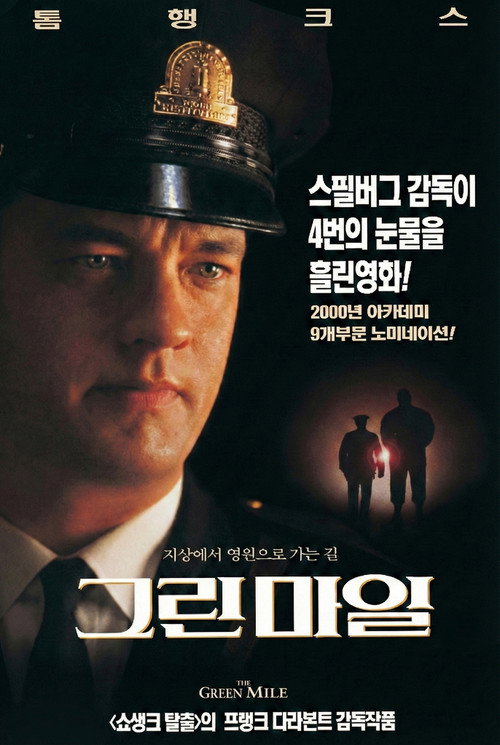
The Execution and Paul's Guilt
On the day of John Coffey's execution, the process in which Paul Edgecomb gives the signal for the electric charge is not simply a plot resolution — it dramatically reveals the collision between professional duty and human conscience. Paul undergoes the moment of becoming an 'accomplice' who kills a miracle, and is tormented by deep guilt about the system's absurdity and the nature of justice.
The Clash of Professional Duty and Conscience: The Weight of the Execution
John Coffey's execution scene is the most powerful emotional climax of The Green Mile and the apex of the ethical questions the film poses. In this process, Paul Edgecomb becomes not merely a guard but a 'witness' and 'accomplice' who kills a miracle. This scene maximizes Paul's internal conflict and poses to audiences the question of what justice means.
🕯️ The Planting: The Seed of Doubt
Paul's guilt does not begin at the moment John Coffey is led to the execution chamber. The seed grows from the 'miracle' he received from John and the 'doubts' surrounding that miracle.
- A Crack Through Healing: At the moment John's touch cures Paul's urinary infection, Paul experiences a crack forming in the 'systemic order' he had believed in. This miracle plants in Paul the first doubt that John Coffey may not be a simple prisoner.
- Truth-Tracking: Paul actively steps forward to prove John's innocence. His act of secretly taking John outside the prison at night to heal Warden Moores's wife Melinda's brain tumor shows the human compassion with which Paul tries to protect John — having already crossed his own professional boundaries. This means he has already lost faith in the execution system.
- The Wall of the System: Yet the deep-rooted racial prejudice and systemic bias of the 1930s stand in their way. Paul wants to save John but feels helplessness before the enormous wall built by law and society.
⚡ The Payoff: Paul Before the Electric Chair
On the day of the execution, Paul is assigned the role of executioner who gives the signal for the electric charge. This role is the stage that detonates all the guilt and fear he has been suppressing.
- Command and Hesitation: Paul endures extreme pain in the process of giving the execution command. He struggles even to give the order or meet John's eyes, tormented by the guilt of having to kill a miracle with his own hands. This hesitation proves that he is not simply a professional but a human who feels moral responsibility for John's life.
- Witness to Sin: Paul intuits at this moment that he is becoming a 'witness to sin' and an 'accomplice.' His tears are not merely an expression of sadness — they are a symbol of individual, ethical resistance to the cruelty of the system.
- John's Final Request: The scene in which John says he is afraid of the dark and asks not to have the hood placed over him shows that John maintains human dignity until his very last moment. This small request is the decisive catalyst that further collapses Paul's heart.
🕰️ A List of Foreshadowing: Recurring Symbols
There are several recurring symbolic elements to note in order to understand this scene.
- The Contrast of Miracle and System: John's healing ability (miracle) is always nullified by the oppressive and inhumane system (electric chair) that is the prison. This contrast runs through the film's core themes.
- The Symbol of Darkness: John refusing the hood, and the surrounding lightbulbs bursting as John disappears into darkness, implies that he is a 'spiritual being' disappearing into a place beyond the reach of the system's light (law and order).
- The Flow of Time and Longevity: Paul's appearance at 108, having endured everything in old age, symbolizes the destined weight of having to carry a 'time-transcending event' — John's death — for his entire life.
⚖️ Why It Is Core to the Work's Identity
The execution scene is the moment that confirms The Green Mile is not a simple prison thriller but a philosophical drama asking 'What is justice?' Paul's anguish symbolizes the violence inflicted on one individual's life by 1930s American society's structural racial discrimination and systemic bias. Paul must function as a component of the system, yet his human conscience refuses that component. This collision makes audiences paradoxically realize that not legal justice but human compassion and moral justice are the true values — by the force of the work itself.
Why It Matters
This scene elevates Paul Edgecomb from a simple professional to a human being mired in moral dilemma. Paul's guilt serves as the most powerful emotional anchor audiences can empathize with, condensing all the film's themes — racial discrimination, the violence of the system, the value of miracles — into the form of individual suffering. Paul's hesitation at the moment of giving the command makes audiences themselves pose the question 'If I were in that situation?' — the work's most important ethical question.
Other 명장면 dives4
- arrow_outward
The Origin of John Coffey's Miraculous Power
John Coffey's miraculous healing ability is interpreted not as a simple supernatural phenomenon but as a 'force of empathy' — the union of extreme despair and humanity's pure goodwill manifesting together. This ability, in the most cruel system of the execution chamber, poses the warmest and most dangerous question, making audiences ask about the origin of justice and human dignity.
- arrow_outward
The True Culprit and the Revelation of Truth
The truth about the case that branded John Coffey a murderer shows that he is not simply a victim but a symbol of justice standing against the system's absurdity. The journey to prove John's innocence is a 'truth-tracking' voyage that transcends legal combat, and this truth is the most fragile and most important element that can only be discovered inside the closed and corrupt system that is the prison.
- arrow_outward
Racial Discrimination in 1930s Louisiana
The 1930s Louisiana prison that serves as the film's backdrop is not a simple jail — it is a space where deep racial discrimination against Black people and structural violence have crystallized. Everything John Coffey suffers is a symbol of the structural violence the system of that era inflicted on minorities, posing fundamental questions about justice and human dignity.

Back to the title
The Green Mile
15 deep dives in total