
Why Saito ages and Cobb doesn't — the asymmetry in how each one perceives Limbo.
Saito at some point accepted Limbo as reality, so its time gnawed at his appearance, whereas Cobb knew all along Limbo was a dream and therefore did not age mentally.
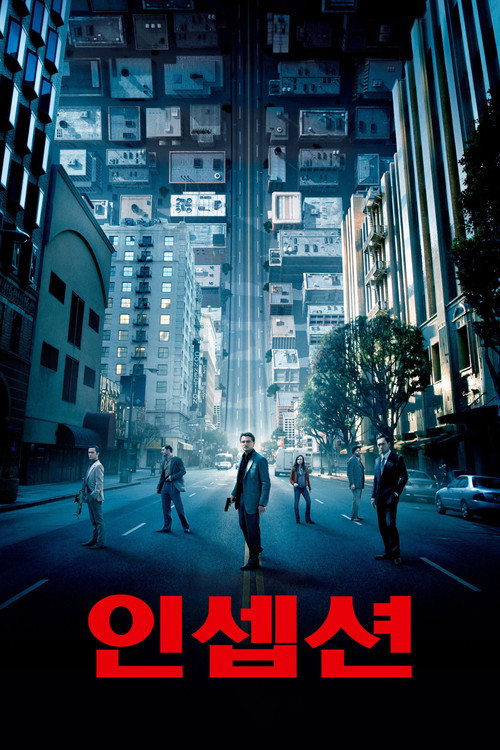
인셉션
Directed by Christopher Nolan · 2010
Dream-extractor Cobb gets one last job: plant a single thought deep in a rival heir's subconscious — the very same thing he once did to his wife.
Chapter 1
13 characters and 16 relationships that hold this story together.
Leonardo DiCaprio
An expert at infiltrating dreams to extract information. A fugitive barred from re-entering the US, framed for the murder of his wife Mal's suicide.
Dig in →
Cillian Murphy
Heir to the energy conglomerate Fischer Morrow. Carries the wound of never feeling acknowledged by his dying father.
Dig in →
Marion Cotillard
Spent fifty years with Cobb in Limbo, then killed herself after his inception left her believing 'this world isn't real.' In the present, she appears as a manifestation of Cobb's guilt who sabotages every job.
Dig in →
Michael Caine
Architecture professor. Mal's father and Cobb's father-in-law. Recommends Ariadne to Cobb as the architect and raises Cobb's children in his absence.
Dig in →
Ellen Page
Professor Miles's architecture student. Designs the labyrinthine dream spaces for the operation. Her name comes from the Greek myth figure who guided Theseus out of the labyrinth.
Dig in →
Ken Watanabe
CEO of rival energy conglomerate Proclus Global. Rides along into the dream himself to verify the job. Wealthy enough to buy an entire airline on the spot.
Dig in →
Joseph Gordon-Levitt
Handles target research and on-mission logistics. Skilled fighter, organized, conservative by temperament. The role was originally meant for the late Heath Ledger.
Dig in →
Tom Hardy
A roguish forger who can shapeshift into other people inside a dream to deceive the target. The most physically capable fighter in the team.
Dig in →
Dileep Rao
Chemist behind Somnacin, the potent sedative stable enough to hold a three-layer dream. The trade-off: dying inside the dream under it drops you into Limbo.
Dig in →
Pete Postlethwaite
Founder of Fischer Morrow. On his deathbed when the film opens. His death triggers the Sydney→LA ten-hour flight that becomes the operation's stage.
Dig in →
Tom Berenger
Fischer's godfather and a top executive at Fischer Morrow. During the job he becomes the figure Eames impersonates and the bait that sows doubt in Fischer's mind.
Dig in →
Lukas Haas
Architect of the opening Saito extraction job. After it fails, he tries to sell Cobb and Arthur out to Cobol, only to be caught by Saito himself.
Dig in →
Raised by Miles after Mal's death. The single motivation that makes Cobb accept the inception job. They finally turn to face him in the closing scene.
Dig in →
Chapter 2
12 pivotal scenes that shaped this story, in order.
The film's first scene. A battered Cobb is found on a beach and dragged into a fortress by Japanese guards. Among his belongings the old man fingers a spinning top and says, 'I've seen this top before — in a half-remembered dream.' Who this old man is and where this place exists are only revealed late in the film at the Limbo reunion with Saito (E-kick-cascade) — the opening half of a perfect frame.
Dominic "Dom" Cobb · Saito
Dig in →
Exploring dreams-within-dreams, Cobb and Mal slip into Limbo, the deepest layer of the subconscious, and live there roughly fifty mental years together. To get back to reality, Cobb inception's into Mal the idea that 'this world isn't real.' She accepts it, denies Limbo, and they take their own lives together to wake up — but the belief carries over into reality.
Dominic "Dom" Cobb · Mallorie "Mal" Cobb
Dig in →
Back in the real world, Mal cannot escape the inception-planted belief that she is still dreaming, and jumps to her death in front of Cobb to "wake up." At the same time she has meticulously prepared letters to her lawyer claiming Cobb threatened her and a psychiatric clearance, designing the whole thing so Cobb would be charged with murder and forced to die alongside her.
“I'm their mother — you think I can't tell my own children apart? This is a projection!”
Mallorie "Mal" Cobb · Dominic "Dom" Cobb
Dig in →
On a bullet train, Cobb, Arthur and Nash attempt an extraction on Saito. Inside a layer-two dream they have tricked Saito into believing is reality, he notices the floor carpet has changed from wool to polyester and realizes he is still in a dream. The failure paradoxically fascinates Saito and leads him to commission the inception job.
“I've always wanted to change this carpet. But it was wool — and this is polyester.”
Dominic "Dom" Cobb · Arthur · Saito · Nash
Dig in →
On Miles's recommendation, Cobb starts teaching Ariadne dream architecture, recruits Eames in Mombasa, and brings in chemist Yusuf through Eames. Saito insists on riding along to verify the job. When the team objects that inception is impossible, Cobb says he has 'done it before' — the first hint of what he did to Mal.
Dominic "Dom" Cobb · Ariadne · Eames · Yusuf +2
Dig in →
The death of Fischer Morrow founder Maurice puts heir Robert on a Sydney→LA flight for the funeral. Saito buys the entire airline so the team can lock down the first-class cabin, and Cobb, seated next to Fischer, slips the sedative into his drink to launch the job.
Saito · Robert Michael Fischer · Maurice Fischer · Dominic "Dom" Cobb
Dig in →
Yusuf's dream, a rain-soaked city. They kidnap Fischer, but his militarized subconscious fights back and shoots Saito, putting him on the brink of Limbo. In this layer Eames transforms into Browning to plant in Fischer the idea of his father's 'real will' and a fake safe code, 528491.
“The deal still holds.”
Dominic "Dom" Cobb · Arthur · Eames · Yusuf +3
Dig in →
Arthur's dream, a hotel. The layer-one van rolling and free-falling translates into zero gravity here. Arthur fights Fischer's projections in a rotating corridor and improvises a new 'kick' by detonating an elevator shaft to create artificial gravity. Meanwhile the team convinces Fischer himself to descend voluntarily into layer three.
Dominic "Dom" Cobb · Arthur · Ariadne · Eames +1
Dig in →
Eames's dream, a fortress in the snowy mountains. Just as Fischer reaches the safe, Cobb's subconscious Mal storms in and shoots him. Cobb kills her in turn, but Fischer falls into Limbo before he can wake. At the same time the wounded Saito dies in layer one and joins him there. At Ariadne's suggestion, Cobb and Ariadne hook themselves into the PASIV to drop into Limbo and bring Fischer back.
Dominic "Dom" Cobb · Ariadne · Eames · Robert Michael Fischer +2
Dig in →
In Limbo, Cobb finally tells Mal's projection that she is only a shadow of the real Mal and lets go of his guilt. Ariadne shoots Mal and pushes Fischer out of Limbo to wake him; back in the fortress Fischer finds his father's real will and his childhood pinwheel, and accepts as his own belief the single line: his father didn't want him to be just like him.
“Because we'll be together!”
Dominic "Dom" Cobb · Ariadne · Mallorie "Mal" Cobb · Robert Michael Fischer +1
Dig in →
Edith Piaf's 'Non, je ne regrette rien' plays as the cue, triggering layer 3→2→1 kicks in cascade. The team wakes one by one, but Cobb stays in Limbo to find Saito. After what feels like decades of wandering he reaches the now-elderly Saito. This scene frames the film's opening (Cobb found on a beach) as a perfect bookend.
“I've seen this top before. In a half-remembered dream.”
Dominic "Dom" Cobb · Saito · Ariadne · Arthur +2
Dig in →
Twenty minutes before landing, a single phone call from Saito clears Cobb's murder charge and he passes immigration. At Miles's home Cobb spins the top, but the moment his children turn to look at him he leaves the totem behind and runs to them. As the top wobbles still spinning, the INCEPTION title rises and the film ends.
Dominic "Dom" Cobb · Saito · Stephen Miles · Philippa and James Cobb
Dig in →
Chapter 3
4 central characters examined in their own dedicated essays.
Character study
protagonist
On the surface Cobb is the apex of his profession: an extractor at the top of his game. But the real weight he carries is not skill, it is guilt. His wife Mal, with whom he spent fifty years in Limbo, could not shake the conviction that 'this world is fake' even after returning to reality, and killed herself in front of him on their wedding anniversary — and the film's true wound is that the person who planted that false certainty deep in her subconscious safe was Cobb himself. Late in Limbo he confesses this to Ariadne and articulates his own discovery: an idea, once inception'd, holds in reality too and cannot be undone. The trace of that regret shapes how he runs the Fischer job. Plant a single line, but make it connect naturally to Fischer's own arc of self-growth — so it doesn't gnaw at his life the way the false certainty gnawed at Mal — by placing his father's real will and his childhood pinwheel inside the layer-three safe to dress the plant as a reconciliation. The asymmetry of Limbo perception is also central to him. Mal and Saito both came to believe Limbo was reality, but Cobb knew throughout that it was a dream, so after wandering decades to find Saito his face hadn't aged. The reading that his real totem might be the wedding ring rather than the top dovetails exactly with this asymmetry: the ring he removes in reality and unconsciously wears in dreams is the proof that his conscious mind let Mal go but his unconscious never did. So in the ending, walking away from the top to run to his children isn't 'refusing to check the truth' but 'choosing the present with my family over the truth' — the resolution Nolan himself confirmed in interviews around the release of Oppenheimer.
Read the full dive →
Character study
tragic figure
Mal is the surface antagonist of the film, but she is also the greatest victim of inception. She and Cobb reached Limbo together and aged through fifty years there. As Limbo began to feel like reality she hid her totem — the spinning top — in the safe at the bottom of her subconscious and began to deny that 'this is a dream'; to pull her back out, Cobb opened that safe and set the stopped top spinning again — inception'ing into her deepest interior the certainty that 'this world is not real.' The inception worked; they came back to reality by suicide, but the lie Cobb planted came with her, intact. Here is the central twist: Mal didn't confuse dream and reality because her judgment fogged — she was completely sane and was simply, powerfully holding onto the single lie Cobb had planted. Precisely because she remained sane, she could get a clean psychiatric clearance, send false letters to her lawyer, and design her own death as a trap that would frame her husband for murder. So inside the film there are really two Mals: the actual Mal who returned to reality and killed herself, and the projection of Mal who afterward haunts Cobb's subconscious and sabotages every job. Her cry in the flashback fight, 'I'm their mother — you think I can't tell my own children apart? This is a projection!', is the accusation she throws at the real children she sees, but viewed at the scale of the whole film it lands as tragic irony — because she herself is now a projection inside Cobb's subconscious, threatening the children and colleagues he sees. Her madness is not the madness of an unhinged mind; it is the tragic consistency of someone with a single truth lodged in the deepest place.
Read the full dive →
Character study
team member
Ariadne is, on the surface, the team's architect — a graduate student in architecture brought in on Miles's recommendation to build the dream stages. The naming is deliberate: in Greek myth Ariadne was the figure who gave Theseus the thread to escape the labyrinth. But as the film advances her second function becomes increasingly clear — she is Cobb's internal guide. She does not stay in the architect's lane; she keeps pushing into Cobb's subconscious and past, asking the question no one else on the team will ask: who exactly is Mal, and why does she wreck every job? The pivotal moments also pass through her hands. In the snow fortress she stands beside Cobb pressing him to shoot Mal, and in Limbo she is the one who finally pulls the trigger on Mal herself. The reading that, separate from the surface Fischer job, she was carrying out an inception on Cobb at Miles's request — a father-in-law's commission to release his son-in-law from trauma, hidden as a second job inside the first — only holds together on top of these details. By the end of the Limbo confrontation Cobb has accepted that the Mal he keeps seeing is only a projection, and lets her go: intentional or not, Ariadne has run on him an inception that planted the single line 'release Mal.' That her totem is a hand-built metal chess bishop is equally suggestive. The bishop moves only diagonally — an attack from the flank, not the front — and that is exactly how she came at Cobb: not through the front of the operation, but from the side, running the real inception there.
Read the full dive →
Character study
client
Saito is the client of the operation and, at the same time, its weakest participant. When he insists on riding along to meet Yusuf the chemist, Eames pushes back: 'No room for tourists.' That jab is a compressed diagnosis of the whole character — he cannot keep pace with the rhythm of a professional team, a man whose place is built only by power and capital. Shot in the layer-one rain chase by Fischer's subconscious and eventually dying into Limbo, Saito accepts the flow of Limbo time as it comes and ages drastically — the exact opposite of Cobb, because he perceived Limbo as reality. The decisive piece is that his deepest fixation is aging itself. At the helipad, in the layer-one warehouse, and in the Limbo fortress, he speaks the same line three times: 'Will you wait, alone, growing old, with nothing but regrets?' That fear is precisely what made him most vulnerable to Limbo's time. The film's opening — an old Japanese man finding a wrecked Cobb and taking him into a fortress — only reveals itself late as the elderly Saito, a bookend that visualizes the weight of the time he waited for Cobb. And when he tells Cobb 'The deal still holds' while dying in layer one, it isn't a comforting line. He had set Cobb's clearance in motion before takeoff by multiple channels and instructed his people to 'cancel it if my call doesn't come' — a man who designed his promise to activate automatically even if he died. The trained intuition that lets him spot a dream by ambient wrongness — without needing a totem — maps perfectly to the layer-one extraction scene where he is the first to notice the change in the carpet's material. He is the figure who, at his most powerful, holds together both the opening and the closing of the film at his weakest.
Read the full dive →
Appendix
Saito at some point accepted Limbo as reality, so its time gnawed at his appearance, whereas Cobb knew all along Limbo was a dream and therefore did not age mentally.
Cobb takes the ring off in reality and only wears it in dreams; in the ending plane and homecoming scenes there is no ring on his finger, the director's quiet signal that the ending is real.
Michael Caine has said that every scene he appears in is reality, and the very act of Cobb walking away from the totem to run to his children is itself proof of his choice: 'dream or real, it doesn't matter anymore.'
That she enters on Miles's recommendation, relentlessly digs into Cobb's subconscious and past, and is the one who finally shoots Mal in Limbo strongly suggests a hidden second job: a father-in-law's request to release his son-in-law from his trauma, smuggled inside the main operation.