arrow_back
Interstellar
Special Pick
Interstellar

Interstellar

인터스텔라

Directed by Christopher Nolan · 2014

On a dying Earth where only corn still grows, former NASA pilot Cooper rides a wormhole near Saturn in search of a planet humanity could live on — but the place he finally reaches is his beloved daughter's room, and specifically the space behind her bookshelf.

Chapter 1

Web of Characters

15 characters and 12 relationships that hold this story together.

Mini Map

Joseph Cooper

protagonist

Matthew McConaughey

Former NASA test pilot. After NASA was shut down he became a corn farmer; the coordinates spelled out by dust falling in his daughter Murph's room lead him to a hidden NASA. He captains the Endurance through the wormhole — but the place he finally lands is the space behind his daughter's bookshelf.

Dig in →

Murphy Cooper

protagonist

Mackenzie Foy / Jessica Chastain / Ellen Burstyn

Cooper's daughter. At ten she meets a 'ghost' in her bedroom and decodes the Morse code STAY. She becomes John Brand's student and spends her life chasing the gravity equation, until the quantum data her father sends via the second hand of his watch finally lets her complete the answer for humanity's exodus.

Dig in →

Amelia Brand

deuteragonist

Anne Hathaway

John Brand's daughter, biologist on the Endurance. Lover of the first-wave explorer Edmunds. She argues for the Edmunds planet over the Mann planet — 'love is the one thing that transcends time and space' — loses the vote, and at the end is proven right.

Dig in →

John Brand

supporting

Michael Caine

NASA research lead. Heads the Lazarus Project. The film's true man behind the curtain. Knowing Plan A was impossible without data from inside the black hole, he sent Cooper into space without revealing it. On his deathbed he confesses the lie to Murph.

Dig in →

Hugh Mann

antagonist

Matt Damon

Leader of the twelve Lazarus astronauts and humanity's finest mind. Knowing his planet was uninhabitable, he sent back a false signal. When the second wave arrives, he tries to kill Cooper by pushing him off a cliff, then tries to commandeer the Endurance and is killed when an unsafe docking causes explosive decompression. The very name 'Hugh Mann' is a metaphor for 'Human.'

Dig in →

Tom Cooper

supporting

Timothée Chalamet / Casey Affleck

Cooper's son. Holds, on the surface, to the farm-promise he made his father and stays on the land to the end. Unlike Murph, he keeps sending video letters to his father — until he finally says 'I'm letting you go' and stops transmitting. He loses his firstborn Jesse.

Dig in →

Doyle

supporting

Wes Bentley

Explorer. On the Miller planet, while waiting for CASE to come back with Amelia, he is swept away by the giant wave. The character who, inside the film, re-enacts the tragedy of the 1914 Shackleton expedition the ship Endurance was named after.

Dig in →

Wolf Edmunds

supporting

Particle physicist; Amelia's lover. The only one of the twelve Lazarus astronauts who, without lie or error, found a planet that was actually habitable — only to be crushed by a landslide just after entering hibernation. The fact that at the end Amelia can take off her helmet and breathe proves his report was right.

Dig in →

Getty

supporting

Topher Grace

NASA doctor. Goes to examine Tom's family when they fall ill from the environment, and is hit by Tom. He shares a kiss with Murph after she shouts 'Eureka' and solves the gravity equation — presumed to be her eventual husband.

Dig in →

TARS

supporting

Bill Irwin (voice/operation)

A monolith-shaped AI, originally a US Marine Corps combat robot. Honesty and humor are dialed on sliders. Survives the KIPP explosion and, during the Gargantua swing-by, separates his own craft to grab singularity data, then transmits the quantum payload that saves humanity. The name is an anagram of 'a tesseract' (Tars et Case).

Dig in →

KIPP

minor

Dr. Mann's assistant robot. Correctly detected that the planet was uninhabitable, which is why Dr. Mann smashed him and set him to self-destruct on boot to cover the lie. Named after the film's science consultant Kip Thorne.

Dig in →

Donald

supporting

John Lithgow

Cooper's father-in-law. Remembers a time of abundance — 'every day used to feel like Christmas; six billion of us trying to have it all.' Raises his grandchildren while Cooper is gone, passes away of old age, and is buried beside his daughter and great-grandson Jesse.

Dig in →

Romilly

supporting

David Gyasi

Physicist on the Endurance. Stays on the mother ship during the Miller-planet excursion and waits alone for 23 Earth years. Dies booting up KIPP, which Dr. Mann had wired to self-destruct.

Dig in →

Laura Miller

supporting

Biologist on the Lazarus mission. Mistakes the giant wave for a mountain range, broadcasts a 'habitable' signal, and is swept away moments later. Because of the planet's time dilation, the signal was still transmitting when the second wave arrived.

Dig in →

CASE

supporting

Josh Stewart (voice)

Same model as TARS, more taciturn. Pulls Amelia out from under the debris on the Miller planet, and after Dr. Mann's death numerically assists the docking with the Endurance spinning at 67 RPM. Settles with Amelia on the Edmunds planet at the end.

Dig in →

Chapter 2

Threads of Time

16 pivotal scenes that shaped this story, in order.

  1. A wormhole appears near Saturn (48 years before film time)

    One day a wormhole — known only in theory — abruptly appears near Saturn. On the hypothesis that someone has opened it deliberately for humanity, NASA secretly launches the Lazarus Project. As revealed later, the 'someone' turns out to be humanity itself, evolved into five-dimensional beings in the future.

    Dig in →

  2. Twelve Apostles of Lazarus — twelve people to twelve planets

    Named after the biblical figure raised from the dead, the project sends twelve astronauts — led by Dr. Mann — through the wormhole to twelve planets in single-seat Rangers + habitation modules. Send a signal if the place is habitable, then hibernate; if not, die where you land. All twelve were volunteers without families.

    Hugh Mann · Laura Miller · Wolf Edmunds

    Dig in →

  3. 2067 — an Earth that grows only corn, dust falling in Murph's room

    Yellow dust and blight have wiped out wheat and okra in sequence, leaving only corn. The schools teach that the Apollo Moon landing was a Cold War fabrication. After a dust storm sweeps the baseball field, the dust that enters Murph's unshut window forms a pattern via a gravity anomaly. Cooper and Murph decode it in binary and recover coordinates.

    You don't believe humanity went to the Moon?

    Joseph Cooper · Murphy Cooper · Tom Cooper · Donald

    Dig in →

  4. STAY — the father leaving, the Morse on the bookshelf

    After Cooper has decided to join the Endurance, Murph cries that the books that fell off her shelf were arranged in Morse code for STAY — don't go. Cooper leaves her his watch — 'when I come back, we'll compare the time difference' — and at that very moment another book falls from the shelf. Later it is revealed that the 'ghost' behind the bookshelf was his own future self.

    Go away! If you're going anyway, just go!

    Joseph Cooper · Murphy Cooper

    Dig in →

  5. The mountains on the Miller planet were a wave — 23 years are lost

    The Miller planet, near Gargantua, has a time-dilation rate where one hour equals seven Earth years. The moment they land, Cooper sees that the distant 'mountain range' is the planet's water gathered into a single colossal wave. Amelia is pinned under debris and CASE pulls her out, but Doyle, watching the wave too long, is swept away. With the engines flooded, they stay an extra three hours — for Romilly on the mother ship, twenty-three years, four months, eight days pass.

    That's not a mountain. It's a wave.

    Joseph Cooper · Amelia Brand · Doyle · CASE +1

    Dig in →

  6. Tom's video letters — and Murph's first message

    Twenty-three years of video letters spill out at once. Tom marries, loses Jesse, and finally says 'I'm letting you go now, dad' and stops transmitting. Just as the screen seems to be over, an adult Murph appears for the first time and opens with 'Hi, dad. You son of a bitch.' Then, crying — 'I'm now the age you were when you left.'

    Hi, dad. You son of a bitch.

    Joseph Cooper · Tom Cooper · Murphy Cooper

    Dig in →

  7. Is love a hypothesis? — the vote that sent them to the Mann planet

    With fuel for only one more planet, Amelia — already exposed as Edmunds's lover — argues, 'love is the one thing we are capable of perceiving that transcends time and space,' and votes for the Edmunds planet. Cooper and Romilly choose the Mann planet. As the ending shows, the instinct that lost the vote was the one that was right out in space.

    Love is the one thing we're capable of perceiving that transcends time and space.

    Joseph Cooper · Amelia Brand · Romilly

    Dig in →

  8. Dr. Brand's lie — 'Plan A was never possible'

    Back on Earth, Murph holds vigil at the deathbed of her mentor — and the film's hidden architect — John Brand. He confesses that he had known all along that the gravity equation could never be completed without data from inside the black hole, yet sent humanity and his own daughter into space anyway. Murph asks 'did Cooper know?' and gets no answer. The revelation that a project named Lazarus (resurrection) was, from the start, a lie.

    John Brand · Murphy Cooper

    Dig in →

  9. Dr. Mann's false signal, the headbutt on the cliff

    Mann, wakened from hibernation, weeps like a child and embraces the team — but he is the one who, knowing his planet uninhabitable, sent the false signal. KIPP was destroyed to block the truth. On the recon walk he rips off Cooper's comms, hurls them away, and tries to push him off a cliff, eventually shattering his helmet with a headbutt. Cooper barely retrieves the dropped comms and gets a rescue signal to Amelia.

    It is.

    Joseph Cooper · Hugh Mann · Amelia Brand

    Dig in →

  10. KIPP detonates — Romilly's death

    Romilly and TARS attempt to restart the smashed KIPP — into which Mann had wired a self-destruct that triggers on boot. The moment TARS shouts 'Step back!' KIPP leaves behind a cut-off line, 'Please don't make-,' and explodes. Romilly is killed. Only the military-grade TARS survives.

    Please don't make-

    Romilly · TARS · KIPP

    Dig in →

  11. 67 RPM — acrobatic docking

    With automatic docking locked out, Mann forces a manual dock and hatch open, gets blown into space by the resulting explosive decompression and is killed. The blast leaves the Endurance spinning at 67 revolutions per minute (one rotation per second) and falling, having lost two modules and its navigation. 'It's not possible!' CASE cries; 'No, it's necessary,' Cooper answers, and matches RPM with the lander to dock successfully.

    CASE: It's not possible! Cooper: No, it's necessary.

    Joseph Cooper · Amelia Brand · Hugh Mann · CASE

    Dig in →

  12. 90% — Cooper separates

    Fuel is insufficient to reach the Edmunds planet. After a Gargantua swing-by paid for with another 51 years of time, TARS separates his craft first and drops into the black hole. As Amelia is just relaxing, Cooper leaves her with a single line — 'Did you forget, Amelia? 90%.' — and separates his craft too. The promise that both of them could make it was the 10% lie.

    Did you forget, Amelia? 90%. ... Detach.

    Joseph Cooper · Amelia Brand · TARS · CASE

    Dig in →

  13. The tesseract — the ghost behind the bookshelf was his future self

    Past the event horizon Cooper reaches an interface five-dimensional humanity has laid down for three-dimensional beings — a space where Murph's room repeats infinitely in a lattice. Time becomes an axis rather than a flow, and only gravity bleeds through dimensions. He sends young Murph the Morse signal STAY, and inscribes the quantum data onto the second hand of the watch so future-Murph will find it. The 'ghost' he had so badly wanted to push away from his daughter turns out, in the end, to be himself.

    It was you... you were the ghost.

    Joseph Cooper · Murphy Cooper · TARS

    Dig in →

  14. Eureka — Murph completes the answer for humanity

    In her empty childhood room, Murph reopens the notebook with STAY written in it and realizes that 'the only person who could say STAY at this time, in this place, is the father who can never come back.' She catches that the seemingly broken second hand of the watch was in fact Morse code, decodes the quantum data, and completes the gravity equation.

    I called it a ghost because... it was as if it were a person. It was trying to tell me something.

    Murphy Cooper · Getty

    Dig in →

  15. Cooper Station, 2156 — an aged daughter and a young father

    Cooper, recovered in Saturn's orbit, wakes in a memorial built in his honor. Aged 124, subjectively only 2 weeks and 48 hours have passed. A baseball follows curved space and breaks the window of the house above him. Murph, on her deathbed, says, 'My father promised he would come back,' and then — 'no parent should have to watch their child die' — tells him to go to Amelia.

    My father promised he would come back.

    Joseph Cooper · Murphy Cooper

    Dig in →

  16. She takes off her helmet — Amelia was right

    Seventy years late, Amelia recovers Edmunds's body from the landslide and lays his nameplate as a kind of grave marker. Then she removes her helmet and takes a deep breath. That single breath proves the planet's atmosphere and gravity are habitable for humanity, and the majority vote that sent them to the Mann planet is, in retrospect, definitively wrong. Cooper steals a ship and sets out for her.

    Amelia Brand · Wolf Edmunds · CASE · Joseph Cooper +1

    Dig in →

Chapter 3

Forks of Depth

4 central characters examined in their own dedicated essays.

Character study

Joseph Cooper

protagonist

Two truck rides to NASA

Cooper drives to NASA twice in his life. The first time he is following coordinates extracted from Murph's room toward an unknown destination — Murph is in the passenger seat, hidden under a tangle of blankets. The second time he is driving toward the launch of the Endurance. He still lifts the passenger-seat blankets. Knowing his daughter is not under them. Those two truck rides are the emotional coordinate system of the film.

+ 2 more sections

Read the full dive →

Character study

Murphy Cooper

protagonist

The young Murph who did not doubt the ghost

At ten, Murph is a child who calls the books falling from her shelf a 'ghost' and tries to decode them in Morse and binary. The intuition Cooper waves away with 'be scientific about it' turns out, in the end, to have pointed precisely at the future self of her father behind that bookshelf. The film, once again, places a child's unscientific intuition in the position of being right.

+ 2 more sections

Read the full dive →

Character study

Hugh Mann

antagonist

The trap inside the name

Hugh Mann. Pronounce it as written: Human. The deliberate decision to give the name 'human' to humanity's strongest mind — and the charismatic figure who persuaded the twelve apostles to accept death — is the film driving in, in advance, that his fall is in the end the fall of the human average.

+ 1 more sections

Read the full dive →

Character study

Amelia Brand

deuteragonist

A hypothesis dismissed as a private feeling

Her reasoning for the Edmunds planet included a private love, and in the briefing room that private feeling was exposed as a weakness and made the reason she lost. But at the end she takes off her helmet and breathes deep. That single breath overturns all the rationality of the meeting.

+ 1 more sections

Read the full dive →

Appendix

Ripples and Threads

Production (7)

  • The cornfield is not CG: about 500 acres (roughly 2 km²) was grown for six months in Alberta, Canada, and shot live. After filming, all of it was harvested and sold, contributing to the production budget.
  • The dust-storm shots on Earth were finely pulverized cardboard mixed with food-safe additive, blown by industrial fans, while the old-timers' interviews are real archival footage from the documentary 'The Dust Bowl' — actual survivors of the 1930s American Dust Bowl.
  • Both the Miller planet (water) and the Mann planet (ice) were shot in actual Icelandic landscapes; full-scale Ranger and Lander vehicles were craned out to the locations. Anne Hathaway showed signs of hypothermia during the cold-water shoots.
  • Nolan gave Hans Zimmer a short note describing 'a man who must leave his child to set out on a very long journey,' without revealing the film's title or plot. Zimmer composed the kernel of the main theme overnight on that emotion alone. When he later learned it was a space film, Nolan answered, 'Now that we've found the heart of the music, we can expand it into space.'
  • Theoretical physicist Kip Thorne, the film's science consultant and producer, set two conditions: first, no premise may violate established physics; second, every speculation must be grounded in science rather than authorial imagination. ⟦OUTSIDE: After the film's release, in 2017, Kip Thorne shared the Nobel Prize in Physics for the LIGO gravitational-wave detection.⟧
  • The visualization of the black hole 'Gargantua' was rendered by feeding Kip Thorne's physics equations into a supercomputer; two real academic papers were published from data discovered during the process. A rare case of cinematic imagination flowing back into academic discovery.
  • The project was originally to be directed by Steven Spielberg from 2006, but he left when production changed studios. On the recommendation of his younger brother and screenwriter Jonathan Nolan, Christopher Nolan stepped in. Jonathan spent four years studying relativity at Caltech for the screenplay.

Trivia (5)

  • The wristwatch Cooper leaves Murph is a Hamilton Khaki Field Murph model, originally built as a film prop, not as a real product — later released as a regular product in response to fan requests.
  • The Miller-planet sequence underscores its score with a clock-tick spaced at roughly 1.25 seconds. Hans Zimmer set that interval so that one tick equals one Earth day (24 hours) — an audible inscription of the time-dilation ratio.
  • The names TARS and CASE are an anagram of 'a tesseract,' the 4D figure: Tars et Case. (Latin 'et' = 'and.')
  • Dr. Mann's self-destructing robot KIPP is named after the film's science consultant Kip Thorne. There is a wry edge to the fact that the homage is already smashed by the time it first appears on screen, and is eventually obliterated in an explosion.
  • The very name Matt Damon's character bears — 'Hugh Mann' — is a metaphor for 'Human.' The film's theme is anchored in the premise that humanity's strongest mind and the charisma that sent the twelve apostles into space ultimately collapses under fear and the survival instinct, sends a false signal, and attempts murder.

Context (7)

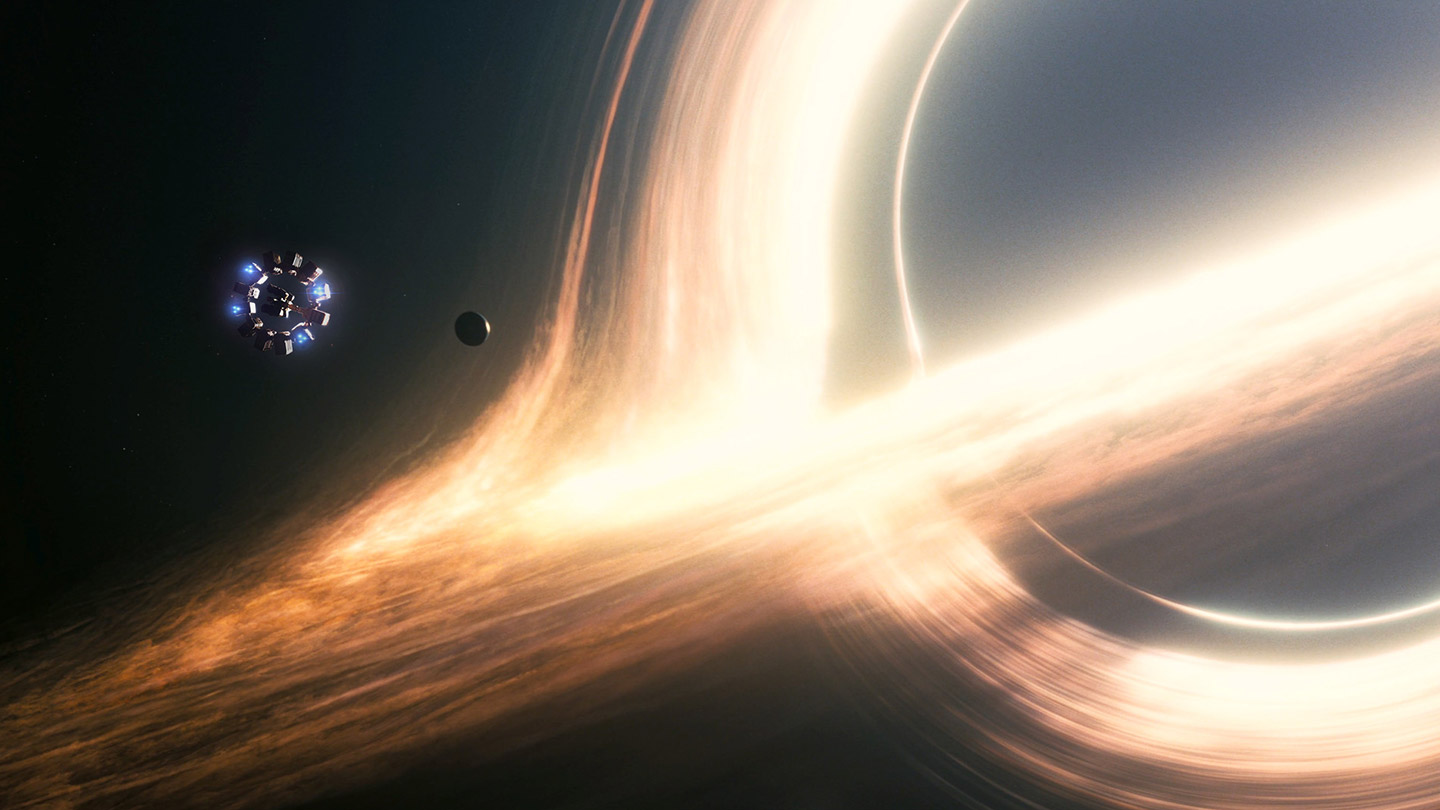
  • In 2019, the first-ever image of a black hole — the M87 galaxy's central black hole, captured by the Event Horizon Telescope (EHT) — turned out to look remarkably like the film's Gargantua. The film, in effect, beat the real-world discovery by five years.
  • The Lazarus mission's twelve-person crew is likely modeled on the twelve apostles of the Bible. The project's name itself, 'Lazarus,' is the figure raised from the dead by Jesus — a motif of human resurrection. By the ending, however, all twelve are dead, with Dr. Mann last.
  • The project name 'Lazarus' carries a surface promise of human resurrection, but as the ending unfolds it turns out that promise was 'a resurrection only for those who hadn't yet died' — a false one. Nolan's hand reaches in for a religious symbol and dismantles it.
  • The mother ship's name 'Endurance' comes from Ernest Shackleton's 1914 Antarctic expedition vessel. That ship was destroyed, but Shackleton crossed the Antarctic seas in a five-person lifeboat and brought everyone back alive. The giant wave that kills Doyle is also inspired by an anecdote of Shackleton's: he had once seen what he took for the sky clearing on the southern ocean, only to realize it was the crest of an enormous wave.
  • Everything that happens inside the tesseract is a closed causal loop in which the cause of an event is the event itself. Cooper sent Murph the data because future humanity existed, and future humanity existed because Cooper sent Murph the data. ⟦OUTSIDE: In physics this kind of deterministic time structure is called Novikov's self-consistency principle.⟧
  • One hypothesis in modern physics holds that gravity is weak because its force is leaking into other dimensions. The film cleverly borrows this. Because gravity is the only force that operates across dimensions, gravity has to be the medium Cooper, trapped in five dimensions, uses to signal the Murph of the past.
  • 10.31 million admissions in South Korea — only the third foreign-language film ever to pass ten million there. ⟦OUTSIDE: Critic Heo Ji-woong read this as Korean audiences responding to a transcendence achieved through familialism.⟧

Interpretations & Debates

Love is another name for gravity — the instinct that lost the vote was right out in space.

Amelia's line — 'love transcends time and space' — is dismissed as sentimental in the briefing room, but at the film's two decisive moments (Cooper finding the precise moment in Murph's timeline inside the tesseract, and the Edmunds planet actually being habitable) it is proven true after the fact. Just as gravity is the one force that leaks across dimensions, love operates as a filter that picks out information across spacetime.

The real meaning of 'STAY' is not 'stay there' but 'regret your past and leave.'

Cooper in the tesseract sends the Morse code STAY to young Murph trying to hold himself back — but for that signal to be sendable at all, he had to have already left. Only after Cooper reaches a future from which he can cite his own regret does he get the idea to send Murph data using that regret as the medium. 'We will find a way' actually means 'we will keep failing until we find a way.'

The Lazarus (resurrection) promise was a false myth from the start.

The project name promises biblical resurrection, but all twelve apostles die and their leader Dr. Mann sends a false signal. The hidden architect Dr. Brand sent people into space knowing Plan A itself was impossible. What saves humanity is not a religious resurrection but love inside a closed causal loop and dogged trial and error.

The ending is not time travel but a closed determinism.

Cooper could enter the tesseract because future humans had opened the wormhole, and future humans could exist because Cooper, in that place, had sent Murph the data. The structure in which a thing causes itself is not a contradiction from a four-or-more-dimensional vantage. ⟦OUTSIDE: This is Novikov's self-consistency principle.⟧

ⓘ Includes some external sources

Mann's betrayal is not the evil of a villain, but the most ordinary failure of 'a human.'

The name is right there in the data: 'Hugh Mann = Human.' The collapse of humanity's foremost intellect — the charismatic figure who persuaded the twelve apostles to accept death — into 'I fought the temptation of the lie for a long time, but I could not beat the hope that if I just pressed the button, rescue would come' is the mirror the film sets up against its reason/emotion axis. It is the place Mann fell from that humanity, in the end, reaches.

Credits

Screenplay
크리스토퍼 놀란 · 조나단 놀란
Music
한스 짐머
Production
레전더리 픽처스 · 파라마운트 픽처스 · 워너 브라더스 · Syncopy Inc. · 린다 옵스 프로덕션
Interstellar (2014) — feature pick — PAGOPAGO