Readingarrow_outward
The Danger of Prejudice and Mob Psychology
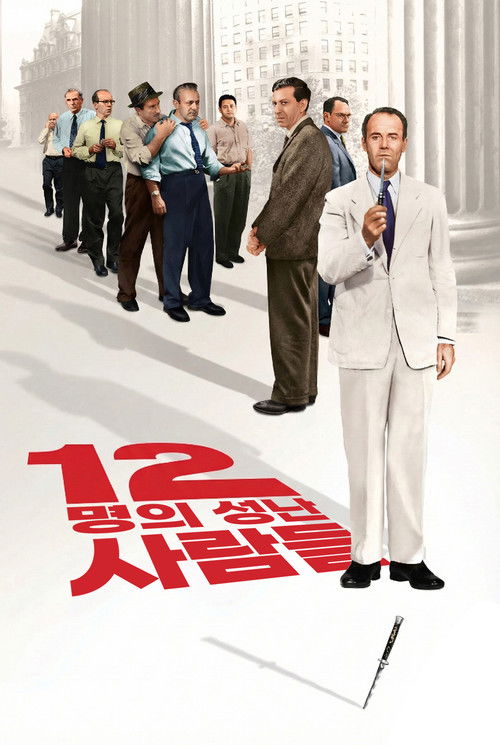
The central theme of this film is to probe the absence of objective truth and the danger of mob psychology created by subjective human prejudice. The unanimous guilty verdict the jurors initially deliver shows how easily people succumb to 'collective certainty,' suppressing individual doubt. The film argues that truth is not an objective list of facts but a subjective process filtered through prejudice — and that breaking through this filter via 'reasonable doubt' is the beginning of justice.
Cardarrow_outward
The Historical Significance of a Low-Budget Film
Regarded as a masterpiece of 1957 legal cinema, this film possesses the characteristics of an extremely low-budget production shot under severely constrained conditions. This very production constraint became the film's greatest virtue — compelling it to focus on meticulous psychological portrayal and sharp dialogue rather than spectacle. As a result, the film established its value as a 'modern classic,' proving the power to overwhelm the audience with nothing more than the tension of a confined space and interpersonal conflict.
Readingarrow_outward
The Separation of Truth and Evidence
The deepest subject of 12 Angry Men is the separation of 'Truth' from 'Evidence.' Rather than clearly establishing whether the boy is guilty, the film offers the legal conclusion that fragmentary pieces of evidence collected and interpreted by human beings can never yield absolute certainty. The process by which the jurors uncover logical flaws in the evidence is a philosophical inquiry showing that truth is not handed down from outside, but must be constructed through the process of reasonable doubt.
Quotearrow_outward
Prejudice always obscures the truth. It's always there in moments like these — personal bias.
Juror 8's line is not merely a warning but the philosophical thesis running through the entire film, declaring that this work is not a simple mystery but a 'drama of reflection.' This sentence pinpoints the gap between the perfection of legal procedure and the fragility of human judgment — pointing out that individual experience, social prejudice, and subjective emotion all distort and conceal truth.
Cardarrow_outward
Psychological Warfare in a Confined Space
The closed space of the jury room is more than a simple backdrop — it is a psychological pressure mechanism that compels the twelve men, with no outside intervention, to reconstruct the truth relying solely on their own logic, emotions, and mutual prejudices. This space meticulously shows how easily human judgment can be swayed by emotional bias, and how painful and difficult the process of arriving at truth truly is.
Characterarrow_outward
Jack Klugman (Juror 5)
Jack Klugman (Juror 5) is a juror with a background as a paramedic from the slums. He approaches the case not through logic alone, but on the basis of his lived experience and his fury at class-based prejudice. His character is a key pillar showing how survival experience — standing against the social prejudice and hate speech of the other jurors — can become a vital counter-argument in the pursuit of truth.
Characterarrow_outward
Martin Balsam (Juror 1)
Martin Balsam serves as the jury foreman among the twelve jurors — not so much the protagonist in revealing the truth as the embodiment of the 'just process of debate' itself. He mediates, guiding the jurors to reach consensus through legal procedure and logical rules rather than being swept by emotion or prejudice, and this process itself conveys the film's core message.
Quotearrow_outward
Who gave you the right to play with a man's life? If you vote not guilty, it had better be because you believe he's not guilty — not because you're tired.
Juror 11's line transcends mere opinion-sharing — it is a philosophical warning that awakens the jurors to the weight and responsibility of their decision. The line shifts the focus of the debate from 'factual matters' to 'moral duty,' conveying the core message that a decision about a human life must never be taken lightly out of boredom or emotional fatigue.
Characterarrow_outward
Lee J. Cobb (Juror 3)
Lee J. Cobb (Juror 3) is a hot-headed, stubborn character who approaches the trial with personal prejudice. Initially insisting loudly on a guilty verdict and creating tension, he is gradually broken down through logical debate and finally — through the photograph of himself and his estranged son — collapses emotionally, realizing that the truth of the courtroom lies not in personal emotion but in 'reasonable doubt.'
Readingarrow_outward
The Legal Weight of Reasonable Doubt
The film's core theme, 'Reasonable Doubt,' is not merely emotional uncertainty — it is a legal condition that arises when all presented evidence and testimony are insufficient to prove guilt with certainty. The film impresses upon the audience the principle that, no matter how compelling the evidence assembled, if 'certainty' is absent, the extreme punishment of death cannot be imposed — arguing that preserving reasonable doubt through legal procedure, rather than uncovering the truth, is the central process of justice.
Characterarrow_outward
E.G. Marshall (Juror 4)
E.G. Marshall (Juror 4) is the most rational and fact-focused of the twelve jurors, serving as the logical anchor of the film's deliberations. He resists being swayed by emotion or prejudice, drilling only into the flaws of the evidence — and through the debate over the female witness's nose impression marks and whether she wore glasses, he performs the decisive role of changing his guilty opinion to not guilty.
Characterarrow_outward
John Fiedler (Juror 2)
John Fiedler (Juror 2) begins appearing timid and easily swayed by others' opinions — the archetypal bank clerk — but in the course of carefully re-examining the evidence and circumstances of the case, transforms his 'instinct' into 'conviction.' His transformation symbolizes how subjective and logically vulnerable human judgment can be, embodying the film's central theme of reasonable doubt.
Cardarrow_outward
The Discovery of the Glasses Mark and the Logical Turning Point
The discovery of the glasses impression mark is the decisive logical turning point in 12 Angry Men that collapses the credibility of testimony long regarded as 'solid evidence.' This scene goes beyond merely uncovering the truth — it shows how subjective and vulnerable to prejudice human judgment can be, impressing upon the audience the weight of the legal concept of 'reasonable doubt.'
Quotearrow_outward
We have a responsibility. I've always thought that democracy was a great thing. We have nothing to gain or lose from this verdict. That's why we have the power.
Juror 11's line transcends mere legal advice — it is a pivotal statement reminding the jury of the weight of their role and the essential civic duty of democracy. This line emphasizes that the jurors must judge not on personal emotion or prejudice, but solely on public duty and the principle of reasonable doubt, elevating the film's thematic consciousness to its peak.
Cardarrow_outward
The Jury System and the Presumption of Innocence
The jury system, the core backdrop of this film, is a democratic mechanism in which ordinary citizens participate in the judicial process to determine a defendant's guilt or innocence. This work is not a detective story simply uncovering the truth, but meticulously explores how subjective and vulnerable to prejudice human judgment can be through the legal principle of 'reasonable doubt.' The principle that even if evidence appears overwhelming, a guilty verdict cannot be rendered if any doubt remains — this runs through the entire work as its central theme.
Characterarrow_outward
Edward Binns (Juror 6)
Edward Binns (Juror 6) is a principled and courteous juror who symbolizes the importance of 'procedural justice' amid the contentious atmosphere of the work. Rather than being swept up in emotional debate, he demands that the jurors take sufficient time to thoroughly re-examine every piece of evidence, serving as a reminder that the jury must maintain reasonable doubt even under pressure.