The Separation of Truth and Evidence
The deepest subject of 12 Angry Men is the separation of 'Truth' from 'Evidence.' Rather than clearly establishing whether the boy is guilty, the film offers the legal conclusion that fragmentary pieces of evidence collected and interpreted by human beings can never yield absolute certainty. The process by which the jurors uncover logical flaws in the evidence is a philosophical inquiry showing that truth is not handed down from outside, but must be constructed through the process of reasonable doubt.
Separating Truth from Evidence: A Philosophical Question Beyond the Legal Drama
12 Angry Men goes beyond a murder trial to offer a meticulous inquiry into the epistemological limits of human knowledge. The film's central message lies in the fact that it never provides a definitive answer to the question 'Did the boy actually commit the crime?' Instead, the jury arrives at the legal conclusion that 'based only on the evidence and testimony we have, we cannot be certain of guilt.' This means that truth (Truth) and evidence (Evidence) must be thought of separately.
Evidence is nothing more than fragmentary pieces collected and interpreted by human beings — and to believe that these fragments assemble into a single grand 'truth' may be a dangerous arrogance. The process by which the jurors uncover the flaws in the evidence demonstrates that truth is not something absolute handed down from outside, but a process that must be constructed by oneself through logical doubt.
1. The Logical Process of Finding the Flaws in Evidence
The first doubt Juror 8 raises — when the initial atmosphere skews toward a guilty verdict — becomes the catalyst for the entire debate. The jurors identify the following flaws in the evidence:
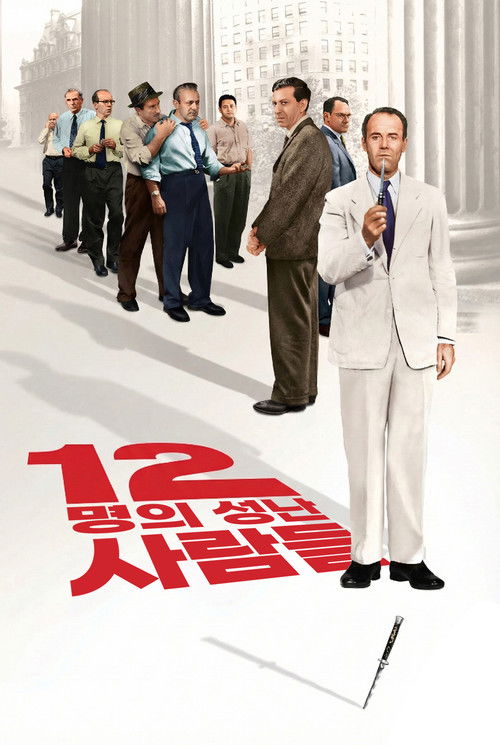
- The origin of the murder weapon: The knife assumed to belong to the boy is virtually identical to one Juror 8 found at a pawnshop, raising fundamental questions about the provenance of the evidence itself. This reveals the danger of interpreting evidence as trapped within the context of 'the crime scene.'
- Contradictions in testimony: The debate over the female witness's testimony maximizes this theme. By excavating the point at which the accuracy of testimony is in question (e.g., the glasses mark), the film shows that testimony may not be 'fact' but rather 'a reconstruction of memory.' The mere possibility that testimony is inaccurate is enough to make a verdict of death impossible.
- Probabilistic thinking: The jurors discuss how low the probability is that two witnesses could simultaneously lie or be mistaken — leading to the conclusion that absolute probability cannot itself be asserted, emphasizing that human reasoning can never be perfect.
2. The Legal Safety Mechanism of 'Reasonable Doubt'
All the debate in this film ultimately converges on the legal concept of 'reasonable doubt.' This term means more than mere suspicion — it signifies that there is sufficient grounds for a reasonable person to harbor doubt.
Through this legal conclusion, the film delivers the following messages:
- Human judgment is subjective: The jurors are easily influenced by personal prejudice, professional background, and private emotion. Because subjective factors so readily intrude, irreversible verdicts such as a death sentence demand the highest possible level of certainty.
- Truth is in the realm of inference: Truth is not the sum total of visible evidence, but belongs to the domain of 'inference' that must pass through the rigorous gate of logical doubt before it can be declared. Therefore, no matter how powerful the evidence appears, if it cannot pass through the gate of 'reasonable doubt,' a guilty verdict is impossible.
Ultimately, this film borrows the form of legal drama to argue that a humble posture of receiving 'doubt' before 'certainty' — when confronting truth — is essential.
Why It Matters
This theme elevates 12 Angry Men from a simple legal thriller to a drama of depth grappling with human psychology and legal philosophy. Through 'reasonable doubt,' the film poses the fundamental question 'what is truth?' to its audience. This matters not only for the fairness of judicial proceedings but also as a demonstration of how vulnerable human judgment can be to prejudice and subjectivity — suggesting why the ability to discern truth amid today's information overload is so important. It is this theme that has ensured the film's enduring place as a classic cited continuously in the fields of law, philosophy, and ethics.
Other Reading dives2
- arrow_outward
The Danger of Prejudice and Mob Psychology
The central theme of this film is to probe the absence of objective truth and the danger of mob psychology created by subjective human prejudice. The unanimous guilty verdict the jurors initially deliver shows how easily people succumb to 'collective certainty,' suppressing individual doubt. The film argues that truth is not an objective list of facts but a subjective process filtered through prejudice — and that breaking through this filter via 'reasonable doubt' is the beginning of justice.
- arrow_outward
The Legal Weight of Reasonable Doubt
The film's core theme, 'Reasonable Doubt,' is not merely emotional uncertainty — it is a legal condition that arises when all presented evidence and testimony are insufficient to prove guilt with certainty. The film impresses upon the audience the principle that, no matter how compelling the evidence assembled, if 'certainty' is absent, the extreme punishment of death cannot be imposed — arguing that preserving reasonable doubt through legal procedure, rather than uncovering the truth, is the central process of justice.
Back to the title
12 Angry Men
16 deep dives in total