D
Retired Blade Runner, protagonist · Harrison Ford
A man caught between past trauma and professional conviction. His growing doubt about what separates humans from replicants places him on the very boundary he was hired to police.
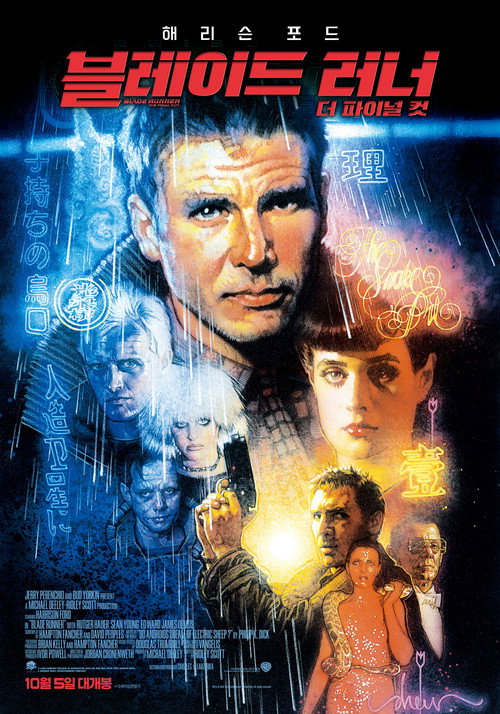
Directed by Ridley Scott · 1982-06-25 · 118 min
In the early 21st century, humanity abandoned a dying Earth to colonize the stars. Born from that exodus, 'replicants' — bioengineered beings virtually indistinguishable from humans — were gifted with near-perfect intellect and physical capability, yet condemned to a lethal four-year lifespan. The specialist police tasked with hunting rogue replicants down and 'retiring' them are known as Blade Runners. Far beyond mere sci-fi action, the film poses the question — What does it mean to be human? — through a cyberpunk cityscape choked with London-style smog and neon light. What are your memories, your emotions, your soul — and who gets to define them?
The setting is Los Angeles in the 21st century, a city ravaged by environmental ruin. Replicants — used as labor in off-world colonies — are outlawed on Earth and subject to execution after staging a massive uprising. Specialist police called Blade Runners track them down. Retired ex-Blade Runner Rick Deckard is pressed back into service to hunt a group of advanced Nexus-6 replicants. As he pursues them, he is drawn ever closer to the truth of what replicants really are — and the blurry line between human and machine tests his convictions and identity at every turn. The chase expands far beyond criminal investigation into a vast interrogation of the nature of life itself.
Retired Blade Runner, protagonist · Harrison Ford
A man caught between past trauma and professional conviction. His growing doubt about what separates humans from replicants places him on the very boundary he was hired to police.
Replicant from the Tyrell Corporation · Sean Young
A replicant implanted with human memories who is unaware of her own nature. Her relationship with Deckard makes her the film's central vehicle for exploring what it truly means to be human.
Leader of the replicants who infiltrate Earth · Rutger Hauer
A replicant of exceptional combat skill and intelligence. He recounts his extraordinary lived memories to Deckard, asserting their equal standing as sentient beings.
Deckard's fellow Blade Runner · Edward James Olmos
A mysterious figure who exerts psychological pressure on Deckard through cryptic actions and dialogue, deepening the film's brooding atmosphere.
A replicant created for pleasure · Daryl Hannah
Roy Batty's lover, whose presence demonstrates the capacity of replicants for genuine emotional connection.
Head of the Blade Runner division, LAPD · M. Emmet Walsh
A character who openly dehumanizes replicants by calling them 'skinjobs,' and serves as the catalyst that draws Deckard back into service.
The replicant four-year lifespan is not a simple plot device — it is the 'built-in obsolescence' mechanism the Tyrell Corporation designed to control the value of their existence. This setting goes far beyond science-fiction interest into a sharp critique of how capitalist society controls and depletes its labor.
The Voigt-Kampff test is the key mechanism in the Blade Runner universe for drawing the boundary between human and replicant. It poses questions designed to provoke subtle emotional responses, then measures the pupil dilation of the subject to distinguish human from replicant — and the film raises fundamental doubts about its reliability.
The implantation of memories in replicants is the film's most central philosophical device. Far beyond merely providing information, it defines the replicants' reason for existence and their claim to 'humanity.' Replicants like Rachael — who hold implanted human memories — embody the film's deepest ambiguity about what it means to be human.
This pivotal scene traces the psychological disintegration of retired Blade Runner Rick Deckard as he carries out his mission to hunt replicants. Having initially dismissed replicants as 'useful or dangerous machines,' his cold professional facade is shattered by his encounter with Rachael — and he comes to stand at the very boundary he was sent to enforce.
The term 'replicant' at the heart of Blade Runner's world-building was born through the process of rewriting the script from its source novel. This renaming goes beyond a simple word substitution — it is the decisive moment that determined the film's philosophical and industrial identity.
The cyberpunk visual language Blade Runner established is not mere backdrop — it is the mechanism that renders the film's core theme, 'the loss of humanity,' in visible form. Set against an early 21st-century ravaged Los Angeles blanketed in London-style smog, the interplay of neon light and shadow articulates the dystopian atmosphere that countless later works would inherit.
Rick Deckard is not merely a retired Blade Runner — he is a philosophical figure searching for his identity within the ambiguity of the boundary between human and replicant. His professional convictions as a replicant hunter are tested at every turn, and through Rachael he finds the boundary between human and machine dissolving.
Rachael is a Tyrell Corporation replicant implanted with human memories, unaware of her own nature. Her existence forces protagonist Deckard to endlessly interrogate the meaning of 'humanity' — and her dual identity as a being designed to live as human drives the film's central mystery and narrative.
Roy Batty is not merely a replicant — he is the leader of a rebellion, yearning for human emotion and memory. Aware that he is treated as a slave, he infiltrates Earth in pursuit of survival and dignity, and his final soliloquy stands as the film's most powerful philosophical statement.
Eduardo Gaff is Rick Deckard's fellow Blade Runner — a figure of enigma who moves through the entire film with a terse, formal manner. He plays a role beyond mere accomplice, embodying the institutional coercion and suspicion inherent in the Blade Runner profession, and serving as a shadow that psychologically presses Deckard.
Pris Stratton moves beyond the replicant model designed as a 'basic pleasure model' to embody the capacity of replicants for emotional connection and self-realization. Alongside Roy Batty, she infiltrates the Tyrell Corporation — and her character arc evolves from a functionally defined object to a subject pursuing her own will.
Harry Bryant is the head of the Blade Runner division at the LAPD — a figure who openly dehumanizes replicants by calling them 'skinjobs.' He is the direct catalyst who pulls the retired Rick Deckard back into service to hunt the advanced Nexus-6 replicants, embodying the institutional prejudice of the era toward replicants.
Blade Runner deconstructs the boundaries of humanity through 'emotion' and 'memory' that transcend biological genetics. Its replicants are crafted to near-perfection, yet as protagonist Deckard pursues them, he comes to realize that the standard for defining humanity rests not on any technical test but on the subjective, elusive quality of empathy.
The deepest question Blade Runner poses moves beyond 'What is human?' to a more fundamental interrogation of 'What is truth?' The film treats memory not as a personal experience but as data that can be controlled and commodified by a vast corporate system — asking the audience: 'Is what you remember actually true?'
Replicants possess intellectual capacity equal to humans but are engineered with a four-year lifespan — a deliberate built-in obsolescence designed for corporate control. Despite this safeguard, a massive uprising occurs, rendering replicants illegal on Earth.
The artificially shortened lifespan represents a mechanism to control replicants' value and existence. It drives them to seek out the chairman of Tyrell Corporation in a desperate bid for life extension — a struggle that stands as the film's symbol of the fight for survival.
The Voigt-Kampff test, used by Blade Runners, poses unsettling questions designed to provoke subtle emotional responses, then measures the dilation of the subject's iris to distinguish humans from replicants.
Depicted as the only reliable method for distinguishing humans from replicants, the film undermines the test's credibility by highlighting its dependence on subjective emotional judgment. Failure to pass results in 'retirement.'
Rachael is a Tyrell Corporation replicant implanted with human memories, leaving her unaware of her own nature. Uncovering this truth becomes the central engine of the story.
Replicant memory goes beyond mere information storage — it defines their purpose and underpins their claim to humanity. Implanted memories can obscure the truth or, paradoxically, serve as the very foundation of a new kind of humanity.
As Deckard carries out his mission to hunt replicants, he finds himself experiencing genuine emotion toward beings like Rachael. He once believed himself superior — standing apart from replicants — but finds himself standing on the very same boundary.
Deckard's emotional disintegration visually enacts the collapse of the boundary between hunter and hunted. It forces him to question the very professional identity — 'Blade Runner' — upon which he has built his sense of self.
The source novel was titled 'Do Androids Dream of Electric Sheep?' but at Ridley Scott's insistence, David Webb Peoples' revision replaced 'android' with 'Replicant.' Original screenwriter Hampton Fancher subsequently departed the project.
This revision profoundly shaped the film's world. By stepping away from the connotations of 'android,' the production adopted the more technical and neutral term 'replicant,' which in turn influenced the film's philosophical and industrial tone.
The film is widely recognized as a pioneer that established the visual vocabulary and thematic concerns of the cyberpunk genre: rain-slicked streets, flying cars, towering buildings, and neon-lit advertisements.
Upon its 1982 release the film was deeply polarizing, but with time its singular, dystopian vision of the future earned enormous influence over subsequent science-fiction cinema — particularly for its visual innovations.
Blade Runner is celebrated as a defining masterwork that decisively shaped the emergence of science-fiction cinema and the cyberpunk genre. Its distinctive visual language — rain-drenched streets, aerial cars, towering skyscrapers, neon signage — became the visual reference point for countless science-fiction works that followed. In particular, its vision of a world where the line between human and machine grows increasingly indistinct became one of the central preoccupations of later science-fiction storytelling.