T
Renowned film director and protagonist · Jacques Perrin
A man with a fanatical passion for cinema. Growing up around the movie house from childhood, he eventually becomes a successful director and returns to his hometown — a life defined by film.
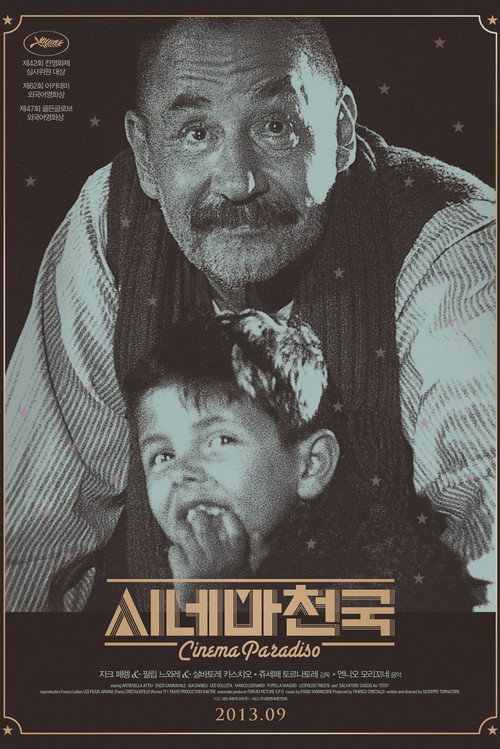
Directed by Giuseppe Tornatore · 1988-11-17 · 124 min · Cristaldifilm
This film shows that cinema can become a 'sanctuary' that sustains a person's entire life and destiny — far beyond mere entertainment. The 1988 Italian masterpiece centers on Totò, who returns to his hometown after thirty years to face the ruins of the Cinema Paradiso. There he retraces memories of Alfredo, the projectionist who raised him, and witnesses how cinema became the record of an entire generation's nostalgia, love, and loss. Most strikingly, the film traces with exquisite delicacy how an external force — censorship — suppresses art, and how those suppressed memories ultimately explode in their most beautiful form.
Renowned film director Salvatore Di Vita (Totò) receives word that Alfredo has died, and for the first time in thirty years returns to his hometown. The story begins as he sinks into memories of the past. Time rolls back to the Sicilian village of Giancaldo just after World War II, where a boy consumed by cinema grows up around the village's only movie house, the Cinema Paradiso. There he meets projectionist Alfredo, learns the craft of projection, and nurtures his dreams — while clashing with his mother over his obsession with films. Years pass; Totò becomes a successful director in Rome and leaves his village behind, but Alfredo's death summons him back. What awaits him is a theater on the verge of demolition and the memory of a first love lost thirty years earlier.
Renowned film director and protagonist · Jacques Perrin
A man with a fanatical passion for cinema. Growing up around the movie house from childhood, he eventually becomes a successful director and returns to his hometown — a life defined by film.
Totò's projectionist and spiritual pillar · Philippe Noiret
The single greatest influence on Totò's life. He teaches projection and nurtures Totò's dreams, yet bids him a tender farewell with the advice: 'Never come back.'
Totò's first love · Agnese Nano
The first love who shared Totò's youth. Their meeting and separation prove decisive to his growth; when they reunite after thirty years, the misunderstanding of the past is finally resolved.
Totò's mother · Antonella Attili
A woman who lost her husband to war and raised Totò alone. She worries about his obsession with cinema and sometimes scolds him sternly.
Alfredo transcends the role of a mere projectionist; he is the most important mentor who designs the arc of protagonist Totò's entire life. He accompanies Totò from the earliest stage of his passion — sometimes as a stern critic, sometimes as a warm teacher — and his presence is the backdrop of every stage of Totò's dreaming, stumbling, and maturing.
Totò transcends the figure of a mere film enthusiast; he is a man who builds his identity and the destiny of his life through the medium of cinema. His life — set against the backdrop of a ruined hometown movie house — embodies artistic passion, loss, and the power of unforgettable memory.
Cinema Paradiso is celebrated not merely as a commercially successful film but as a work that contributed to redefining the identity and artistic value of Italian cinema in an era of decline — making it profoundly significant in cultural history. Jury Grand Prize at Cannes, Golden Globe, Academy Award, BAFTA: it swept the global film circuit.
At the heart of Cinema Paradiso lies the philosophical theme of 'the preservation of memory,' beyond simple nostalgia. The ruined theater and the reels of film Totò receives from Alfredo embody the impulse to hold on to pure moments that resist the passage of time — crystallized into the most beautiful form.
Totò and Elena's reunion in Cinema Paradiso transcends simple romance — it is a psychological journey through the great current of 'time' to unearth truths and misunderstandings buried beneath thirty years. The two people who face each other are not reconciling a romance; they are reckoning with the past.
In Cinema Paradiso, 'censorship' transcends a mere plot constraint — it is the most powerful external force threatening the very 'memory' that Totò and Alfredo have guarded, their pure artistic experience. This essay tracks how censorship recurs throughout the film, and how in the end it is transformed into the most beautiful form.
The theater fire and Alfredo's rescue provide the decisive turning point that shapes protagonist Totò's life. The blaze that breaks out during an outdoor screening is more than a crisis — it is the moment Totò steps beyond the position of mere spectator to become a projectionist who takes responsibility for the fate of cinema itself.
The 'Cinema Paradiso' in the film is more than a screening venue — it is a 'sanctuary' upon which all of protagonist Totò's memories and emotions from childhood to adulthood are projected. This space symbolizes a purity and artistic passion frozen in time, and stands as the ultimate object of censorship and external suppression.
Alfredo's mentorship is more than a transfer of technical skill — it is the process of teaching protagonist Totò the most important value in life: 'independence.' From the turning point of the elementary school graduation exam, Alfredo instills in Totò the message encoded in 'Never come back' — and it becomes the driving force behind Totò's entire life.
The line Alfredo delivers to Totò transcends mere career advice — it symbolizes the loneliness, unending labor, and personal sacrifice inherent in the life of an artist. In Cinema Paradiso, this line is the moment when a fanatical passion for cinema becomes the full weight a human life must carry.
Elena is the first love who defines Totò's youth and serves as the emotional axis of Cinema Paradiso. Her meeting and parting with Totò prove decisive to his growth, while their reunion thirty years later is not a simple romance but an unraveling of long-buried truths about time and memory.
Maria Di Vita is more than a supporting character — she is the most powerful 'wall of reality' in protagonist Salvatore Di Vita (Totò)'s artistic life. Her life, losing her husband to war and raising Totò alone, makes her experience Totò's immersion in cinema as a direct threat to their survival.
Cinema Paradiso argues, beyond simple nostalgia, that 'memory' itself is the most powerful and beautiful medium of art. The ruined theater Totò confronts after thirty years has physically disappeared, yet the reel Alfredo reveals at the end — assembled from moments censored and suppressed by external forces — proves that no memory truly dies.
Young Totò loves films so much that he hoards film reels, nearly causing a fire. Meanwhile Alfredo watches as the local priest's censorship forces crucial scenes to be cut from the films. This is the pivotal device showing how easily artistic freedom can be suppressed by external forces.
In this film, censorship is interpreted not merely as control but as an act of editing memory itself. The reel that Alfredo hands Totò at the end is assembled from countless kisses and romantic scenes cut by the censor — a moment when suppressed beauty explodes into the open, symbolizing the triumph of memory over repression.
In the film, the space called 'Cinema Paradiso' is described as far more than a mere theater — it is recalled as 'too beautiful a time,' a moment frozen like fate itself. This space is portrayed as an unforgettable, beautiful experience and the site of a fateful encounter that endures like eternity.
In this film the theater transcends physical space to become the stage upon which the protagonists' memories are projected. As time passes and the theater faces demolition, the loss of that space is directly tied to the characters' pasts, evoking an even deeper sense of loss.
When Totò sits his elementary school graduation exam, the late-starting student Alfredo agrees to show him the ropes of the projection booth in exchange for taking the exam. Through this process Totò learns the craft of filmmaking and nurtures his dream, while Alfredo leaves him with the life advice: 'Never come back.'
Alfredo's teaching is far more than a transfer of technique. It carries the message of 'independence' — that Totò must carve out his own life, endure hardship, and grow on his own terms. This counsel becomes the driving force behind Totò's success in Rome.
During an outdoor screening that Alfredo arranged for the overflow crowd unable to enter the theater, the projector's film catches fire and the movie house burns to the ground. While everyone flees, Totò races into the burning theater and pulls out the unconscious Alfredo — an act that changes both their lives.
This incident is the decisive turning point that fundamentally transforms the relationship between the two men. Alfredo survives but loses his sight; Totò, through this experience, grows from a mere spectator into a projectionist who takes responsibility for the fate of cinema itself.
When Totò grows up and falls in love with the beautiful Elena, their relationship ultimately becomes a bittersweet memory swept away by time and Alfredo's advice. When they meet again after thirty years, Elena confesses that she had once tried to find Totò, but Alfredo had hidden that fact — and a misunderstanding had been born.
Their reunion is far from a simple romantic reconciliation. It is a process of unearthing a truth buried by 'time' — a complex psychological journey of reconciling past misunderstanding with present emotion.
This film is credited with reviving the Italian film industry, which had been in decline during the 1980s. It won the Jury Grand Prize at Cannes in 1989, the Golden Globe for Best Foreign Language Film the same year, and the Academy Award for Best Foreign Language Film in 1990, earning worldwide renown.
This award-winning track record shows that the film contributed to redefining the identity and artistic value of Italian cinema, beyond being a mere romance. The film's success symbolized the cultural revival of an entire era.
The film explores childhood nostalgia, love, and longing, following protagonist Totò's coming-of-age journey. Its music underscores the emotional atmosphere of treasuring memories and the passing of time, evoking 'too beautiful a time' to let go.
The film's power comes not from 'perfect happiness' but from the longing for 'a lost beauty.' Because the audience knows every moment cannot last forever, they receive each of those moments all the more tenderly.
You're alone all the time, like a slave. Watching the same film a hundred times, talking to Greta Garbo! No days off — not Christmas, not Easter. Only Good Friday, and if Jesus hadn't died on the cross, we wouldn't even get that.
Cinema Paradiso is celebrated as far more than a romantic comedy — it is seen as a symbol of the revival of Italian cinema. It firmly established Giuseppe Tornatore's artistic identity and set the template for translating 'nostalgia' as a universal emotion into cinematic narrative. The film's success breathed new life into Italian cinema of the 1980s.