S
A seasoned detective on the verge of retirement · Morgan Freeman
A figure who carries a cynical, skeptical view of the case yet refuses to let go of essential justice. He reins in Mills's impulsive actions and steers the investigation.
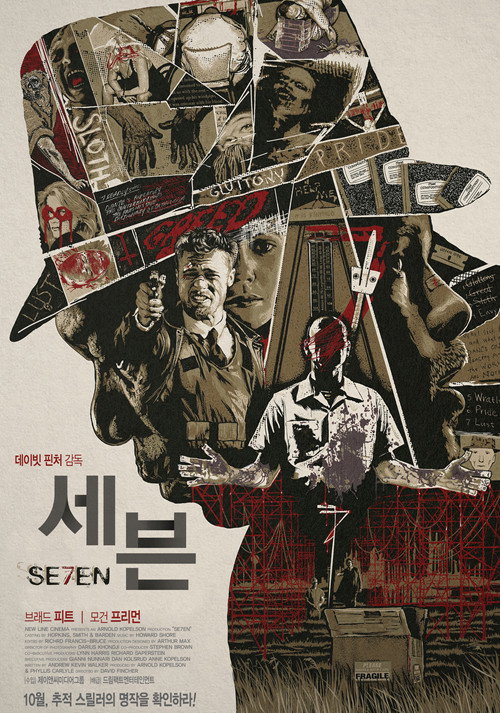
Se7en
Directed by David Fincher · 1995-09-22 · 127 min · New Line Cinema
Set against a relentlessly gray, rain-soaked city, this hard-boiled crime thriller follows two detectives hunting a serial killer who uses the Seven Deadly Sins as a blueprint for murder. The contrasting perspectives of the seasoned Somerset, on the verge of retirement, and the passionate rookie Mills drive to the very heart of the case. The killer's meticulous clues, and the dark human desires they expose — this film reaches far beyond a simple mystery to confront audiences with the philosophical question: 'What is justice, and how must we live?' pulling them into an abyss of uncomfortable truths.
Veteran detective William Somerset, nearing retirement, is assigned a bizarre serial murder case alongside passionate rookie David Mills. The killer begins on Monday with 'Gluttony' and methodically murders victims according to each of the Seven Deadly Sins. Somerset senses that the killer is not a mere murderer but an intelligent schemer with a grand message to deliver. As the two detectives trace the killer's trail, their pursuit leads them deeper into the vast labyrinth he has designed. Throughout this process, the two detectives find themselves torn between the boundaries of law and justice, and the most primal human emotions.
A seasoned detective on the verge of retirement · Morgan Freeman
A figure who carries a cynical, skeptical view of the case yet refuses to let go of essential justice. He reins in Mills's impulsive actions and steers the investigation.
A hot-headed rookie detective · Brad Pitt
A man of fierce conviction and emotional intuition. He pushes back against Somerset's cool rational approach, driving the investigation with his passion for the case. His emotional eruption becomes a pivotal turning point.
Mills's wife · Gwyneth Paltrow
A key ally who provides the detectives with important clues. Her dilemma goes beyond personal privacy to raise the question of what it means to protect life and motherhood in this bleak city.
Police officer · John Cassini
A supporting character representing the police perspective at crime scenes, illustrating the brutality of the crimes and the difficulty of the investigation.
John Cassini (Officer Davis) goes beyond a mere supporting character to represent the institutional limitations of the investigative process against the brutality of crime. He embodies the 'system' perspective of law and order, serving to imprint upon the audience how meticulously the killer John Doe evades the police investigative net. His presence emphasizes that this film is not a simple mystery but a philosophical thriller exploring the gap between 'legal justice' and 'moral justice.'
Somerset is a seasoned detective nearing retirement who symbolizes the importance of 'legal procedure' and 'systematic justice' in the process of tracking the Seven Deadly Sins serial murder case. He restrains the passionate and emotional pursuit of rookie Mills and serves as an intelligent guide elevating the case from simple crime-chasing to a vast social and philosophical labyrinth.
Tracy goes beyond a mere supporting character to represent the most humane values of 'everyday life' and 'motherhood' against the backdrop of the extreme violence of the Seven Deadly Sins. Her dilemma is a question of how to protect ordinary life in this bleak city, providing the audience with the greatest psychological contrast within the vast labyrinth the killer has designed.
Se7en deconstructs the very concept of 'justice,' depicting the sharp clash between systemic justice that values legal procedure and personal justice that follows emotional intuition. While Somerset near retirement upholds law and principle, Mills approaches truth through instinctive passion. At the collision point of these two perspectives, the film throws the audience the fundamental ethical dilemma of 'what is true justice?', securing philosophical depth that transcends simple crime-chasing.
The fingerprints, photographs, and murder journals left by Se7en's killer are not mere traces of crime but a meticulously designed theatrical stage aimed at investigators. The killer uses victims' fingerprints to stage crime scenes and creates an 'orchestration' that subtly deceives the police. This process shows that the killer has an intelligent plan to go beyond mere killing to deliver a grand message about 'justice' and 'truth.'
The core identity of Se7en is formed not merely by plot but by the overwhelming visuals of a drab gray cityscape in perpetual rain. This gloomy, oppressive color palette maximizes the hard-boiled crime thriller atmosphere and serves to visually project the moral decay and dark desires inherent in humanity that the characters face.
Somerset's cold principled approach and Mills's passionate intuitionism represent more than mere detective contrast — they pose the fundamental philosophical question of 'the method of realizing justice.' The collision of these two detectives dramatically illustrates the gap between rational justice operating within the bounds of law and instinctive justice that explodes through emotional rage, forming the core narrative axis of the film.
David Mills is a hot-headed rookie detective who stands in stark contrast to the cool rationality of Somerset. He leads the investigation with pure passion and emotional intuition, showing the intense belief that 'you have to pour out your emotions' in response to the question 'What is justice?' His actions drive the film's hard-boiled atmosphere and confront the audience with an uncomfortable question about the boundaries of justice.
Se7en sharply critiques the fundamental distortion endemic to modern media: in tracking a serial killer themed around the Seven Deadly Sins, journalists focus not on truth but on sensational coverage and attention-grabbing. The film delivers the philosophical message that truth is hidden in the darkest, least-noticed corners, confronting the audience with the fundamental question of 'what is true justice?'
'Long is the way and hard, that out of Hell leads up to light' is the killer John Doe's key philosophical message. This phrase goes beyond a simple warning to hint at how painful and complex the realization of human redemption and justice truly is, forming the thematic foundation that runs throughout the entire work.
Se7en is a philosophical thriller that probes the fundamental human guilt and problem of redemption beyond simple crime-chasing, using the universal human original sin of the Seven Deadly Sins as its subject. The film presents not the act of punishing sin, but the painful process of humans confronting and 'recognizing' their sins as the most important judgment, confronting the audience with uncomfortable questions.
The Seven Deadly Sins serial murder structure — the core structure of Se7en — is not merely a crime plot but like a vast 'sermon' symbolizing humanity's fundamental guilt and moral collapse. The way the killer commits murders themed around each sin structures humanity's dark desires and guilt that law and justice cannot capture, posing philosophical questions to the audience.
The phrase 'Long is the way and hard, that out of Hell leads up to light' — left by the killer — becomes the basis for his interpretation that his serial murders are a 'purification' process for humanity's guilt and redemption. This phrase provides the structural framework of the Seven Deadly Sins and, posing grand philosophical questions of justice and moral perfection, draws audiences into the abyss of uncomfortable truth.
The killer commits murders themed around the Seven Deadly Sins (Gluttony, Greed, Sloth, Lust, Pride, etc.), with events unfolding from Monday through Sunday. This is not a simple murder case, but a kind of 'sermon' that structures mankind's most primal sense of sin.
Each crime inflicts a specific form of suffering on the victim according to the sin, constituting a form of 'judgment' that goes beyond mere killing. Notably, the clues left by the killer are meticulous devices designed to lead victims to confront their own guilt.
Somerset, facing retirement, resists taking the case and insists on legal procedure (warrants), while Mills charges into scenes driven by emotion. This clash between the two detectives raises the fundamental question of 'how to deliver justice.'
Somerset holds to the principle 'we need a warrant' and stays within the bounds of law, while Mills cries 'we have no business being here!' and follows emotional intuition. This conflict functions throughout the film as an opposition between law and emotion, reason versus instinct.
The killer uses victims' fingerprints to stage murder scenes, even leaving murder journals and photographs to implicate himself. This reveals the killer's meticulous ability to orchestrate scenes, subtly deceiving investigators.
Notably, a woman who appears to be a prostitute in one photograph is speculated to be the next target, suggesting the killer enjoys not just killing but 'artistic staging.' This is the core psychological pressure device deployed against investigators.
The killer's note — 'Long is the way and hard, that out of Hell leads up to light' — cuts to the film's core theme. It metaphorizes the painful process humans must endure to become moral and complete beings.
This phrase goes beyond a simple warning to symbolize the difficulty of human guilt and redemption. Through it, the killer seems to believe that the murders he commits are a kind of 'purification' process.
The film is set against a drab, gray cityscape of perpetual rain, maintaining a consistently bleak and oppressive visual atmosphere. This played a decisive role in creating the dark, heavy mood of the case.
This visual element maximizes the hard-boiled genre characteristics of the film, continuously conveying psychological pressure and anxiety to the audience.
Long is the way and hard, that out of Hell leads up to light.
Se7en played a decisive role in pulling the crime thriller genre of the 1990s into darker and more intellectually rigorous territory. Many crime films that followed borrowed the archetype of the 'philosophically-driven serial killer' that this film established, and it is regarded as a textbook for the hard-boiled atmosphere and techniques for maximizing psychological pressure.