Characterarrow_outward
Character
Chief Inspector Choi is the figure who led Lee Geum-ja's incarceration, symbolizing the systemic control that forms the backdrop of her revenge drama. He performs a key role in the early stage when Geum-ja's nickname 'Kind-hearted Geum-ja' is formed, and is a figure who symbolizes the starting point of all the pain and imprisonment she endures.
Characterarrow_outward
Character
The Evangelist, played by Kim Byeong-ok, symbolizes an 'outside gaze' that cracks Geum-ja's perfect revenge drama. He holds a one-sided attraction to Geum-ja, then develops an aversion when he witnesses her cold and calculating demeanor after release, and surveils her. His existence serves as the decisive catalyst that dismantles all of Geum-ja's efforts to hide behind the mask of 'Kind-hearted Geum-ja.'
Quotearrow_outward
What did I tell you! Do you know how itchy the soles of your feet can get?! If you scratch them, they tickle! Don't scratch and they itch, scratch and they tickle!
Park Yi-jeong's line — 'What did I tell you! Do you know how itchy the soles of your feet can get?! If you scratch them, they tickle! Don't scratch and they itch, scratch and they tickle!' — erupts in a moment of extreme pain, and beyond being simple humor, it symbolizes the bleak yet fierce vitality of a survivor. Captured within the film's grand revenge narrative, this line adds depth to the work by portraying the most primal and trivial pain humans experience, and the very human humor that blooms within it.
Readingarrow_outward
The Coexistence of Revenge and Atonement
Sympathy for Lady Vengeance wears the outer shell of a simple revenge thriller, but its core lies in endlessly blurring the boundary between 'atonement' and 'revenge.' Is the guilt protagonist Geum-ja displays genuine remorse, or the most elaborate and calculated performance for a perfect revenge? The film dismantles this boundary, asking the audience how subjective and incomplete the very concepts of justice and salvation are.
Readingarrow_outward
Mise-en-scène and Duality
This piece analyzes the core theme of *Sympathy for Lady Vengeance* — the female subject's mode of survival. Geum-ja's 'kindness' functions not as a simple virtue, but as a survival strategy and the most lethal weapon, meticulously designed to protect herself within the gaze of social surveillance and institutional constraint, and ultimately to complete her revenge.
Cardarrow_outward
The Architecture of Geum-ja's Revenge Plan
The setup connecting Baek Han-sang's criminal motive to the material desire of 'buying a luxury yacht' gives this pleasure killer villain not emotional depth but a deflating, ironic reason instead. This blocks the audience from sympathizing with or fearing Baek Han-sang, degrading all his atrocities to the result of 'a supremely trivial desire' and maximizing the work's narrative irony.
Quotearrow_outward
This flower… I give to you. For a comrade has her enemy to face…
Go Seon-suk's line to Geum-ja — 'This flower… I give to you. For a comrade has her enemy to face…' — is not a simple word of comfort. This exchange in the closed space of prison symbolizes the transmission of a survival strategy and a tool of revenge meticulously hidden within the wrapping of 'kindness.' This line captures the decisive moment in which Geum-ja builds her revenge network, and serves as a key device hinting that all her actions were calculated 'kindness.'
Cardarrow_outward
Prison Life and Her Nickname
The Dhammapada is not a simple Buddhist scripture — it is a central symbolic prop in the process of Lee Geum-ja preparing her revenge tools. The word 'Dhammapada' (법구경) itself is a meticulously designed setup device, carrying a double meaning that connects to the firearm term 'caliber' (구경) in Korean. This visually shows that Geum-ja is concealing her thirst for revenge behind the dual mask of religious atonement and a model image, and emphasizes that her very existence is a disguised performance.
Cardarrow_outward
The Border Between Revenge and Atonement
The 'kindness' of Sympathy for Lady Vengeance is not a simple character trait, but a survival strategy meticulously calculated through 13 years of prison life — the central tool of her revenge drama. This piece analyzes in depth how every kindness Geum-ja showed her fellow inmates was a performance for flawless intelligence gathering and the execution of her revenge plan, examining its psychological mechanism and cinematic significance.
Cardarrow_outward
Production Background and Acting Transformation
As the final installment in Park Chan-wook's 'Vengeance Trilogy,' Sympathy for Lady Vengeance philosophically probes human violence and the ambiguity of justice, going beyond simple retribution. The film expands the emotion of revenge from the realm of physical violence into the domain of psychological atonement and guilt, showing that every process the protagonist Lee Geum-ja undergoes is a journey not toward 'perfect revenge' but toward 'a life that knows the weight of sin' — the thematic culmination of the trilogy.
Cardarrow_outward
The Hollow Motive Behind the Revenge
The supporting characters surrounding Geum-ja in *Sympathy for Lady Vengeance* are not simple helpers — they are 'functional resources' supporting the grand narrative of her revenge in physical, informational, and even survival terms. Their assistance is less true friendship than the result of a complex and calculated 'exchange' formed through surviving in the closed space of prison, and functions as an essential element of Geum-ja's revenge drama.
Characterarrow_outward
Geum-ja
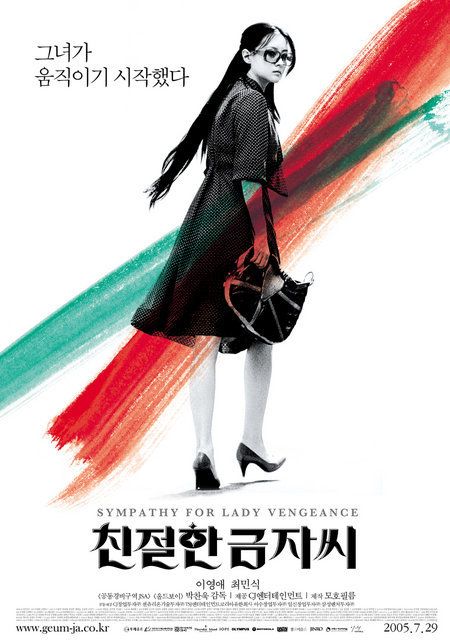
Lee Geum-ja is an avenger who lives behind the mask of exceptional beauty and 'kindness.' Her life is composed, beyond simple retribution, of layers of complex emotion — meticulous performance completed through 13 years of imprisonment, and guilt. Every kindness she showed was a tool for revenge, and in this process she is a tragic figure wandering in search of the true meaning of atonement and salvation.
Characterarrow_outward
Baek Han-sang
Baek Han-sang wears the mask of a kind English teacher and mentor, but in reality is a monstrous kidnapping murderer obsessed with pleasure and control. He is not a simple criminal but one of the most repulsive villains in Park Chan-wook's worldview — transferring guilt and destroying others' lives through a 'noble kidnapping logic,' based on his own trauma and guilt.
Characterarrow_outward
Character
Jenny is Geum-ja's daughter, forcibly separated from her mother when she was adopted to Australia by Baek Han-sang. Her existence is the purest thread of connection that cracks through all the trauma and thirst for vengeance Geum-ja has endured. Her return to Korea 13 years later and her participation in the revenge alongside her mother symbolize the 'life as a mother' and 'normal relationships' Geum-ja had lost, anchoring the film's emotional center of gravity.
Characterarrow_outward
Character
Geun-sik, played by Kim Si-hoo, is an employee at the bakery 'Naruse' where Geum-ja stays after her release, serving as an everyday helper for her revenge plan. He provides Geum-ja with the most ordinary and warm human connection, and carries the symbolic weight of 'normal life' — a contrast to the destructive revenge Geum-ja pursues.