Production Background and Acting Transformation
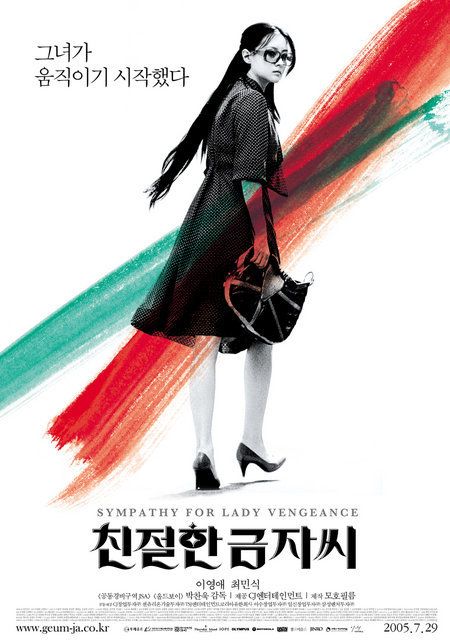
As the final installment in Park Chan-wook's 'Vengeance Trilogy,' Sympathy for Lady Vengeance philosophically probes human violence and the ambiguity of justice, going beyond simple retribution. The film expands the emotion of revenge from the realm of physical violence into the domain of psychological atonement and guilt, showing that every process the protagonist Lee Geum-ja undergoes is a journey not toward 'perfect revenge' but toward 'a life that knows the weight of sin' — the thematic culmination of the trilogy.
Park Chan-wook's Revenge Narrative: Evolution from Violence to Atonement
Sympathy for Lady Vengeance is, in Park Chan-wook's cinematic universe, the concluding installment of the 'Vengeance Trilogy' following Sympathy for Mr. Vengeance and Oldboy — a work carrying the chronological completeness of a vast thematic consciousness in its own right. This trilogy does not simply repeat the genre code of revenge; it poses questions to the audience by progressively expanding how ambiguous the limits of human violence, trauma, and justice truly are.
1. From the Physical Violence of Revenge to Psychological Atonement
In the earlier films, revenge was primarily expressed through physical and direct violence (murder, torture, etc.). The confinement of Oldboy and the violent collisions of Sympathy for Mr. Vengeance were extreme and catastrophic in the causes and consequences of that violence. However, Sympathy for Lady Vengeance shifts the stage of revenge beyond physical retribution into the realm of 'time' and 'psychology.' The 'kindness' Lee Geum-ja built up over 13 years in prison was a performance more meticulously calculated than any act of violence — meaning that revenge is not simply the act of eliminating an enemy, but a painful process of reconstructing one's reason for existence and the sins of the past.
2. The Meaning of the Mask of 'Kindness'
Geum-ja's 'kindness' is the most central device. The model and gentle manner she displayed in prison is a symbol of 'rehabilitation' to outsiders, but in reality it was a process of perfect intelligence gathering and securing helpers in preparation for the plan she would execute after release. This kindness was a kind of defense mechanism she built up by defining herself as a 'witch' — and the most elaborate performance for revenge. All the help she gave those around her was grounded in the calculation that 'this information can be used later.' The fact that 'kindness' — the most human and positive act — is used for the most ruthless purpose is the film's greatest irony and attraction.
3. The Aesthetics of Guilt and the Unresolved Ending
At the trilogy's climax, Geum-ja appears to succeed in her revenge against Baek Han-sang. But the film does not provide the catharsis of satisfying revenge. On the contrary, when Baek Han-sang's additional crimes are revealed, Geum-ja is tormented by guilt: 'if the truth had been exposed then, more victims would not have suffered.' This ending completes Park Chan-wook's theme of 'the absence of perfect justice.' Revenge is not an end but an endless process that only delivers greater guilt and ethical dilemma. That Geum-ja ultimately yields even her revenge to the bereaved families and meets a bitter conclusion argues that true atonement cannot be achieved by legal punishment or physical retribution alone.
4. The Role of Helpers: Solidarity as Complicity
Geum-ja's revenge plan is not accomplished by her strength alone. The various fellow inmates she met in prison — Woo So-yeong, Go Seon-suk, Oh Su-hee — are not mere supporting characters, but 'accomplices' participating in the grand narrative of Geum-ja's revenge. Each carries their own trauma and mode of survival, and in the process of helping Geum-ja's plan they too stand at the boundary of violence and sin. The way multiple characters share each other's sins in their own way and survive through those sins proves that this film is a narrative of collective trauma that transcends individual revenge.
Why It Matters
This entry is the core axis that elevates *Sympathy for Lady Vengeance* from a simple revenge thriller to Park Chan-wook's philosophical chronicle. The structural frame of the 'Vengeance Trilogy' gives coherent thematic consciousness to every element of the film (mise-en-scène, character behavior, the ambiguity of the ending). In particular, shifting the goal of revenge from 'retribution' to 'atonement' and using 'kindness' — the most paradoxical tool — in that process leads the audience to pose the fundamental question: what is justice? Without this structural understanding, Geum-ja's actions risk being interpreted as mere wrongdoing, and the artistic depth the film possesses is lost.
Other 비화 dives4
- arrow_outward
The Architecture of Geum-ja's Revenge Plan
The setup connecting Baek Han-sang's criminal motive to the material desire of 'buying a luxury yacht' gives this pleasure killer villain not emotional depth but a deflating, ironic reason instead. This blocks the audience from sympathizing with or fearing Baek Han-sang, degrading all his atrocities to the result of 'a supremely trivial desire' and maximizing the work's narrative irony.
- arrow_outward
Prison Life and Her Nickname
The Dhammapada is not a simple Buddhist scripture — it is a central symbolic prop in the process of Lee Geum-ja preparing her revenge tools. The word 'Dhammapada' (법구경) itself is a meticulously designed setup device, carrying a double meaning that connects to the firearm term 'caliber' (구경) in Korean. This visually shows that Geum-ja is concealing her thirst for revenge behind the dual mask of religious atonement and a model image, and emphasizes that her very existence is a disguised performance.
- arrow_outward
The Border Between Revenge and Atonement
The 'kindness' of Sympathy for Lady Vengeance is not a simple character trait, but a survival strategy meticulously calculated through 13 years of prison life — the central tool of her revenge drama. This piece analyzes in depth how every kindness Geum-ja showed her fellow inmates was a performance for flawless intelligence gathering and the execution of her revenge plan, examining its psychological mechanism and cinematic significance.
Back to the title
Sympathy for Lady Vengeance
15 deep dives in total