Doubting the veracity of events
Keyser Söze is not simply a villain's name — he is the legendary embodiment of 'deception' that threads through the entire film. His mysterious history and the film's iconic line — 'The greatest trick the Devil ever pulled was convincing the world he didn't exist' — hold the core theme that makes the audience realize every truth it believed was erected on a vast fabrication.
Terror Dressed as Legend: Who Is Keyser Söze?
Keyser Söze is a figure of indeterminate reality in the film — yet the most powerful symbol of terror. He goes beyond mere crime boss: he functions as 'the fateful threat itself' lurking behind every event. His name appears from the film's very opening, and through his backstory — his connection to a Hungarian gang, the incident in which he took his own family hostage — he creates extreme tension.
The manner of his appearances is itself legendary. The scene in which he arrives as Keaton attempts suicide — a figure in a hat extinguishing the light and murmuring 'How you doing, Keaton?' — makes him feel not like an ordinary person but like a mythological judge. This suggests he exists outside the law — a transcendent being.
The Tool of Deception That Dominates the Narrative
Throughout the film the story of Keyser Söze functions as a 'narrative pressure device.' When Kobayashi compels Verbal's group to carry out a mission, Söze's existence imprints on them that they are trapped in an inescapable criminal fate. Verbal describes Söze's background: after Hungarian criminals took his family hostage, he responded by killing his own family before massacring every last gang member — underscoring that Söze is not a common criminal but 'a being beyond rules.'
This poses two questions to the audience. First: can a being this perfect and ruthless really exist? Second: if he does, is there any human means of stopping him?
The Truth Completed by Non-Existence
Every breadcrumb about Söze detonates in the final scene and delivers the film's most important message. Verbal's final line — 'The greatest trick the Devil ever pulled was convincing the world he didn't exist' — redefines everything.
The line carries meaning beyond Söze physically disappearing. Söze was not 'a real threat' but 'a story constructed to make everyone believe.' His name and narrative were the vast psychological device that set the criminals in motion, led the detective through deductions, and drove everyone to seek truth.
Söze was terror for the criminals, a thread for the police, and the most powerful philosophical message for the audience — the most successful fictional creation in cinema history, proving that 'making people believe' can be more powerful than 'actually existing.'
Why It Matters
Keyser Söze is the most important element defining the identity of this film. The Usual Suspects is not a thriller about finding a culprit — it is closer to a philosophical mystery asking 'what is truth?' The Söze character is the core medium of that question. Whether Söze is real is beside the point. What matters is the structural function: how the 'story' of Söze directs characters' behaviour, manipulates the audience's deductive process, and ultimately delivers the message that 'truth is constructed by the observer's perspective and interpretation.' Söze is the symbol that proves the film is not a simple crime thriller but a deep inquiry into human psychology and narrative structure.
Other 떡밥 dives4
- arrow_outward
The meaning and origin of Keyser Söze
The police station office in The Usual Suspects is not merely a backdrop — it is the stage and instrument of fabrication on which Verbal Kint meticulously assembled the great lie to conceal his identity. By treating surrounding objects, bulletin board notices, and the manufacturer name on a cup as if they were truth, Verbal draws the gaze of the audience and Detective Kujan inside the testimony rather than outside the events.
- arrow_outward
The structure and backdrop of the incident
At its core, The Usual Suspects is not a simple crime thriller but a structural masterpiece that dismantles the very concept of 'truth.' The film revolves around the explosion at San Pedro harbor, reconstructing events through the testimony of the sole survivor, Verbal Kint. In doing so, the audience is confronted with philosophical questions about the reliability of testimony, the value of objective evidence, and the inherent corruptibility of memory.
- arrow_outward
Verbal's final walk out of the station
The climax of The Usual Suspects — Verbal Kint's final walk out of the station — is not a mere exit but a visual device showing the return from a perfectly performed 'false self' to the 'true controller.' The gradual straightening of the dragging leg into a confident stride is the most symbolically charged shot in the film and completes the reversal at its highest pitch.
Back to the title
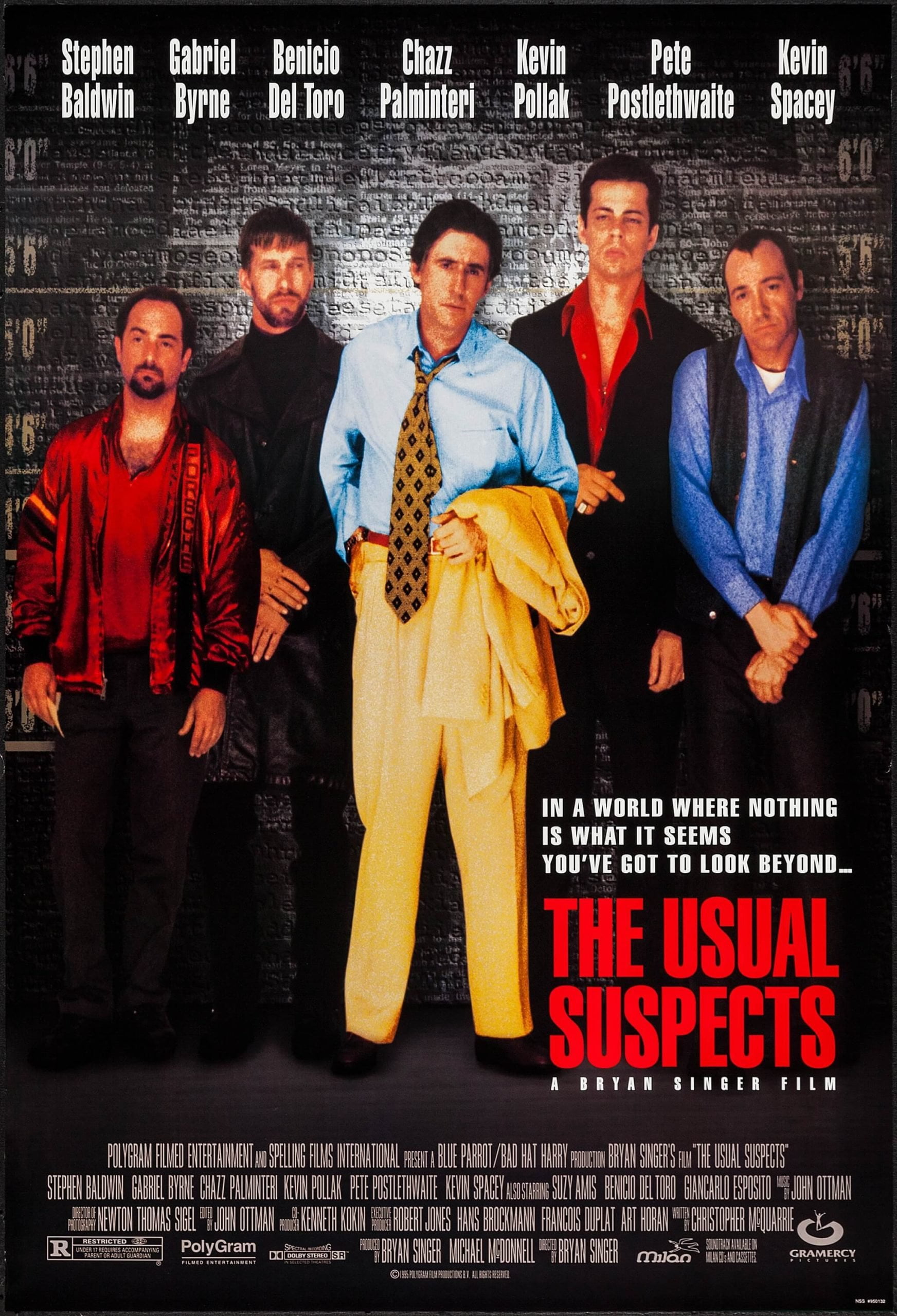
The Usual Suspects
17 deep dives in total