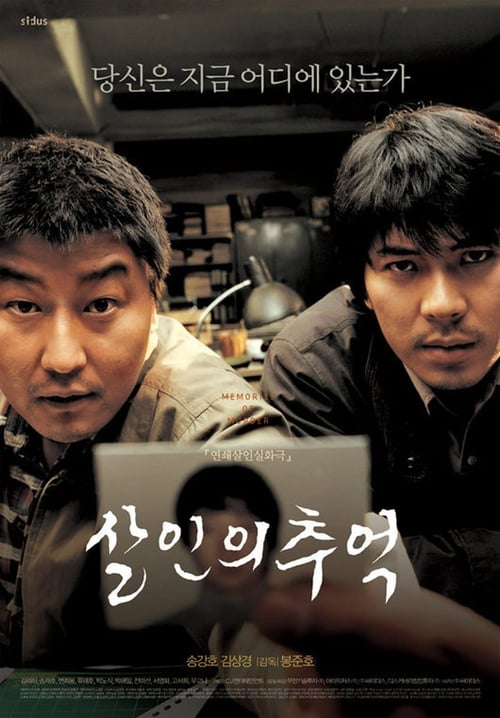
This film is not 'an investigation that fails to find the killer' but 'a great chronicle of defeat for every human capacity to recognize evil.'
Park Doo-man bets on the interior (instinct), Seo Tae-yoon on the exterior (paperwork); both collapse. Park Doo-man stares for a long time into Park Hyun-gyu's eyes and only mutters 'I don't know,' and Seo Tae-yoon sees the DNA report from the US he had trusted most soaked with the blood of his own hand. On top of them piles the defeat of state power as well — a state that, with a blackout drill, made the darkness in which the killings became easiest. To borrow Lee Dong-jin's phrase, the film ends in 'helplessness and lament in the face of evil.'
ⓘ Includes some external sources
Park Doo-man and Seo Tae-yoon start from opposite poles and slide toward each other's positions.
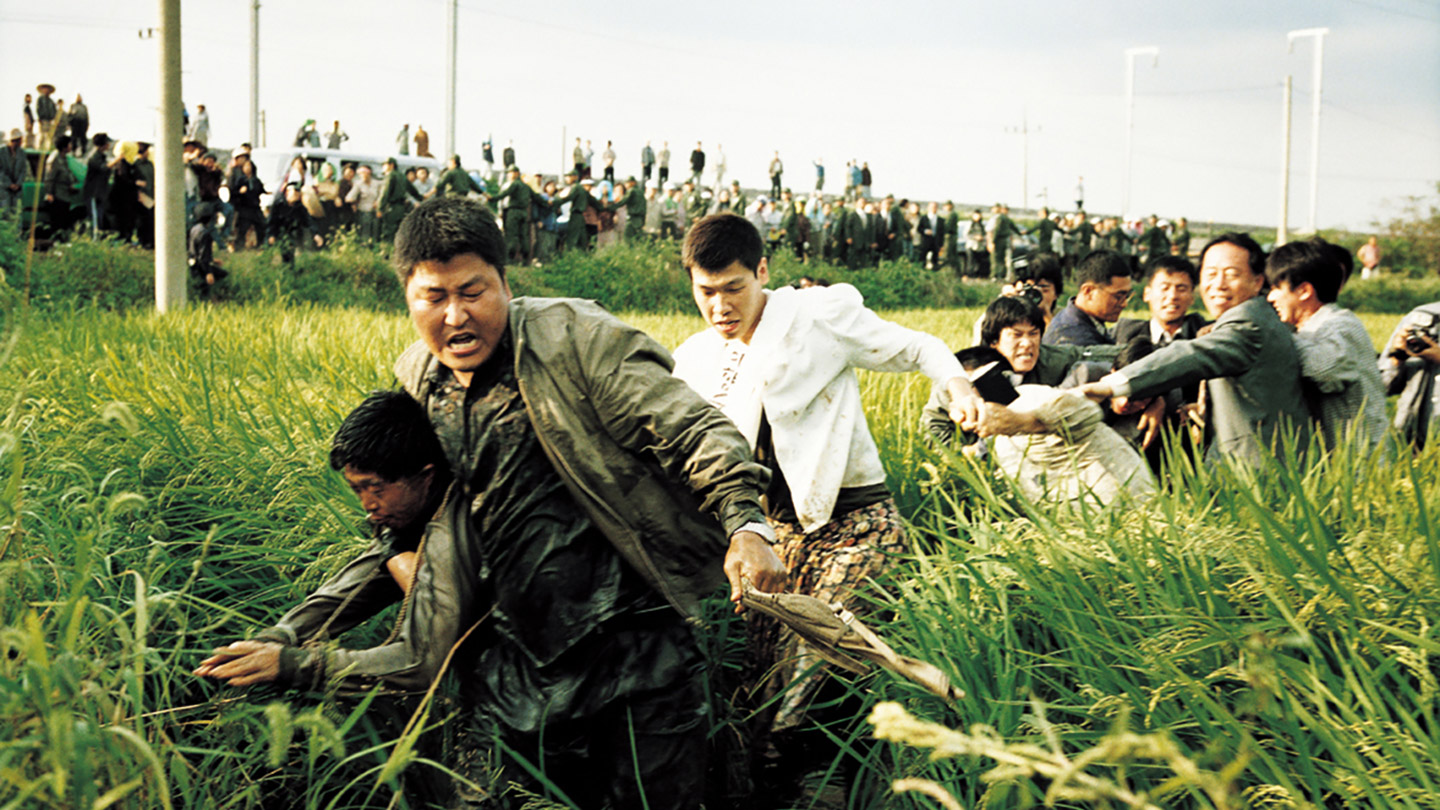
Park Doo-man begins as the country detective who wants to close the case fast with instinct, torture, and fabricated evidence, and Seo Tae-yoon as the elite who believes in paperwork and profiling. By the late film, however, Park Doo-man has gone cold and stands in the way of a runaway Seo Tae-yoon, and Seo Tae-yoon points a gun at Park Hyun-gyu. The two creeds have swapped positions through a single case — which reveals that the early joke (Park Doo-man flying-kicking Seo Tae-yoon on first meeting, mistaking him for a rapist) is in essence a variation that ends with both detectives occupying 'rapist' and 'victim's older brother' positions at once.
ⓘ Includes some external sources
The film's real victims are not only the women, but 'the four men of the system' — Baek Kwang-ho, Jo Byung-soon, Park Hyun-gyu, and Park Doo-man himself.
Baek Kwang-ho was easily framed and killed because of his developmental disability and burn scars. Jo Byung-soon was hung upside down and tortured under the 'pervert' label. Park Hyun-gyu was treated as an outsider for having soft hands and reading books. Even Park Doo-man, the ostensible perpetrator, is a victim of a backward investigation system — a state with riot police diverted to suppressing protests and without the genetic-testing equipment of its own. As Lim Jung-sik puts it, the victim-structure of the four men is different in form, but in cause they all touch the same barbaric power structure of the 1980s.
ⓘ Includes some external sources
Read more strongly, Park Doo-man himself is the symbol of the socio-political real killer of the Hwaseong case — the state power of the 1980s military regime.
The grasshopper boy in the opening wears the same clothes and hairstyle as Park Doo-man and mimics his words and gestures. The camera, after deliberately staging a mirror prop, equates the two. The shot after Baek Kwang-ho is hit by the train holds a close-up on Kwang-ho's blood on Park Doo-man's hand ('I finally got blood on my own hands'). The Bucheon Police Station sexual-torture case and the Hwaseong red-shirt killings both happened in 1986, and the syllable 'Doo' in Park Doo-man and 'Tae' in Seo Tae-yoon overlap with the names of the two presidents — Chun Doo-hwan and Roh Tae-woo, military-academy classmates. The final stare into the camera reads, inverted, not as the detective looking at the killer but as the killer looking out at the audience. ⟦OUTSIDE: This allegorical reading is a strong claim made on a Korean film blog (theqoo, '소름돋는해석'), and Bong Joon-ho has never publicly endorsed this schema in an official interview. He has, however, said: 'reading the details about the critique of the military regime, I realized one could think of it this way too.'⟧
ⓘ Includes some external sources