arrow_back
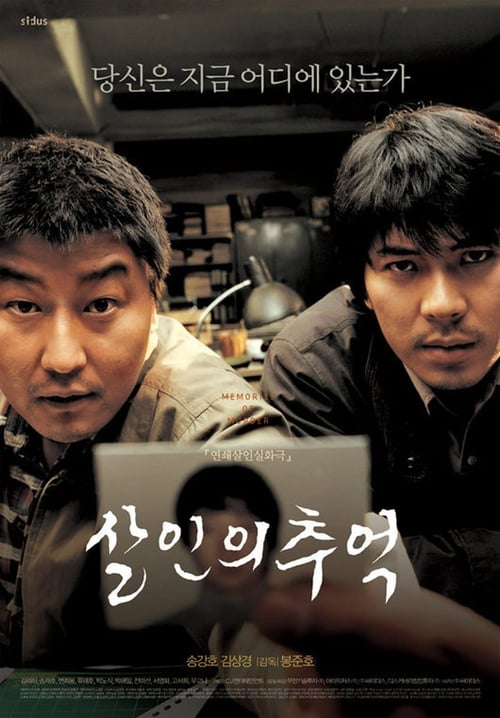
Memories of Murder
Special Pick
Memories of Murder

Memories of Murder

살인의 추억

Directed by Bong Joon-ho · 2003

An unsolved-case thriller set in the paddies of 1980s Hwaseong: country detective Park Doo-man and Seoul detective Seo Tae-yoon — instinct on one side, paperwork on the other — both watch their convictions collapse as they hunt a serial rapist-killer they can never catch, only to realize they themselves were accomplices of the era.

Chapter 1

Web of Characters

13 characters and 8 relationships that hold this story together.

Mini Map

Park Doo-man

protagonist

Song Kang-ho

A country detective of the old school, his tools instinct, superstition, and torture. He claims to be 'Shaman Eyes,' able to read a face and know the criminal — but as the case deepens he doesn't grow calm so much as empty out. The man who, at the end of the film, looks straight into the camera.

Dig in →

Seo Tae-yoon

protagonist

Kim Sang-kyung

A four-year-degree elite detective whose creed is 'paperwork never lies.' He starts out laughing at the provincial cops, but after the middle-school student Kim So-hyun — whom he had once helped at the school infirmary — is murdered, he is the first to break, and points a gun at Park Hyun-gyu.

Dig in →

Jo Yong-koo

supporting

Kim Roi-ha

Park Doo-man's junior, and the icon of military-boot brutality in the film. He tramples Baek Kwang-ho, kicks female student protesters with his boots, and swings to a degree that suggests a rage-control disorder. In the end that leg is impaled on a rusty nail, contracts tetanus, and is amputated.

Dig in →

Baek Kwang-ho

supporting

Park No-shik

A young man treated as the village fool because of his developmental disability and burn scars. In fact the one and only witness to the first murder, but pressed into a forced confession by Park Doo-man and eventually killed by a train. A trauma from his father — that telling the truth brings calamity — kept his mouth shut.

Dig in →

Park Hyun-gyu

antagonist

Park Hae-il

The last suspect, in whose direction every piece of circumstantial evidence pointed — the killings began the moment he started at the factory after discharge, every rainy night he requested Yoo Jae-ha's 'Sad Letter' on the radio, and his hands were soft and white. But the DNA test that arrives from the US releases him. Bong Joon-ho secretly told Park Hae-il, 'play this on the belief that you are not the killer, that you are innocent.'

Dig in →

Shin Dong-cheol

supporting

Song Jae-ho

The cool-headed successor with a Gyeongsang accent. He sees through Park Doo-man and Jo Yong-koo's incompetence and throws his weight behind Seo Tae-yoon's rational investigation. His own temper is gruff: he throws chairs at the squabbling detectives, and personally beats Jo Yong-koo for using violence. At the end, in front of Kim So-hyun's body, all he can do is feebly push away a reporter's recorder.

Dig in →

Kim So-hyun

victim

Woo Go-na

The middle-school student who, on a rainy night at a checkpoint, told the detectives the story of the schoolhouse-restroom killer. She had once had a bandage put on her back by Seo Tae-yoon in the school infirmary. Tae-yoon finds, on her raped and murdered body in the woods, the same bandage he had once given her.

Dig in →

Kwak Seol-young

supporting

Jeon Mi-seon

Park Doo-man's girlfriend. Earning extra income by going house to house giving IVs and injections, she lets slip the gossip she collects to Park Doo-man — gossip that lands Baek Kwang-ho as the first suspect. She nearly becomes a victim in the last killing, but the killer chose Kim So-hyun instead.

Dig in →

Jo Byung-soon

supporting

Ryu Tae-ho

The second suspect, arrested while masturbating at a crime scene. A devout Protestant, but with a paraphilia that aroused him at descriptions of murder, which Park Doo-man took as proof. Beaten and tortured into a false confession, his innocence is proven when a fifth murder occurs while he is in the interrogation room. Criminal-psychology professor Park Ji-sun has called him the suspect closest to the real Lee Choon-jae.

Dig in →

Koo Hee-bong

supporting

Byun Hee-bong

The good-natured chief Park Doo-man calls 'Old Man.' He tries to close the case quickly on Baek Kwang-ho's false confession, but at the reconstruction it is exposed that Kwang-ho's hand is paralyzed from burn complications, and the chief is publicly humiliated and dismissed at the end of his term.

Dig in →

Kwon Kwi-ok

supporting

Ko Seo-hee

The female detective stuck in the bias of the era, given the coffee runs at meetings and called 'Miss Kwon.' Yet she is the one who finds the correlation between rainy nights and Yoo Jae-ha's 'Sad Letter,' and the one who first gets a surviving victim to open her mouth.

Dig in →

Ending Girl (played by Jung In-sun)

Witness at the 2003 ditch, the film’s final face

Jung In-sun

A young girl Park Doo-man encounters when he revisits the ditch in 2003. Her closing lines — "It’s just an ordinary face... just... ordinary" — pull the viewer directly into the lens. Bong Joon-ho later admitted regret over giving such adult-coded phrasing to a child actor, saying "the grammar was too grown-up for a child to speak." Played by Jung In-sun.

Dig in →

Bong Joon-ho (extra-diegetic speaker)

The director himself — interview voice after Lee Chun-jae’s 2019 arrest

A speaker slot for Bong Joon-ho’s own remarks made outside the film. A joke he traded with his crew in 2003 — "Won’t the real killer come to see this movie?" — turned into a real possibility after Lee Chun-jae was identified in 2019. The single question he said he would ask if a prison visit were possible — "Do you remember the people you killed?" — converges in this slot. The OUTSIDE- prefix marks that this is meta-commentary surrounding the film, not a character within it.

Dig in →

Chapter 2

Threads of Time

9 pivotal scenes that shaped this story, in order.

  1. The grasshopper boy on the paddy and the first body (autumn 1986)

    On a golden paddy ridge a boy catches grasshoppers in a glass jar and hides them. Park Doo-man arrives on a tractor and finds the nude body of a woman in the irrigation ditch. The camera pulls focus first onto a grasshopper on her thigh, then to Doo-man — the opening compositional premise that evil looks into the detective before the detective looks into evil. Song Kang-ho's signature line — 'Bullshitting around. Did they smear honey on the paddy or what, that you've all got your noses in the dirt?!' — explodes in the same two-minute long take.

    Bullshitting around. Did they smear honey on the paddy or what, that you've all got your noses in the dirt?!

    Park Doo-man · Koo Hee-bong

    Dig in →

  2. Baek Kwang-ho's arrest and the reconstruction humiliation

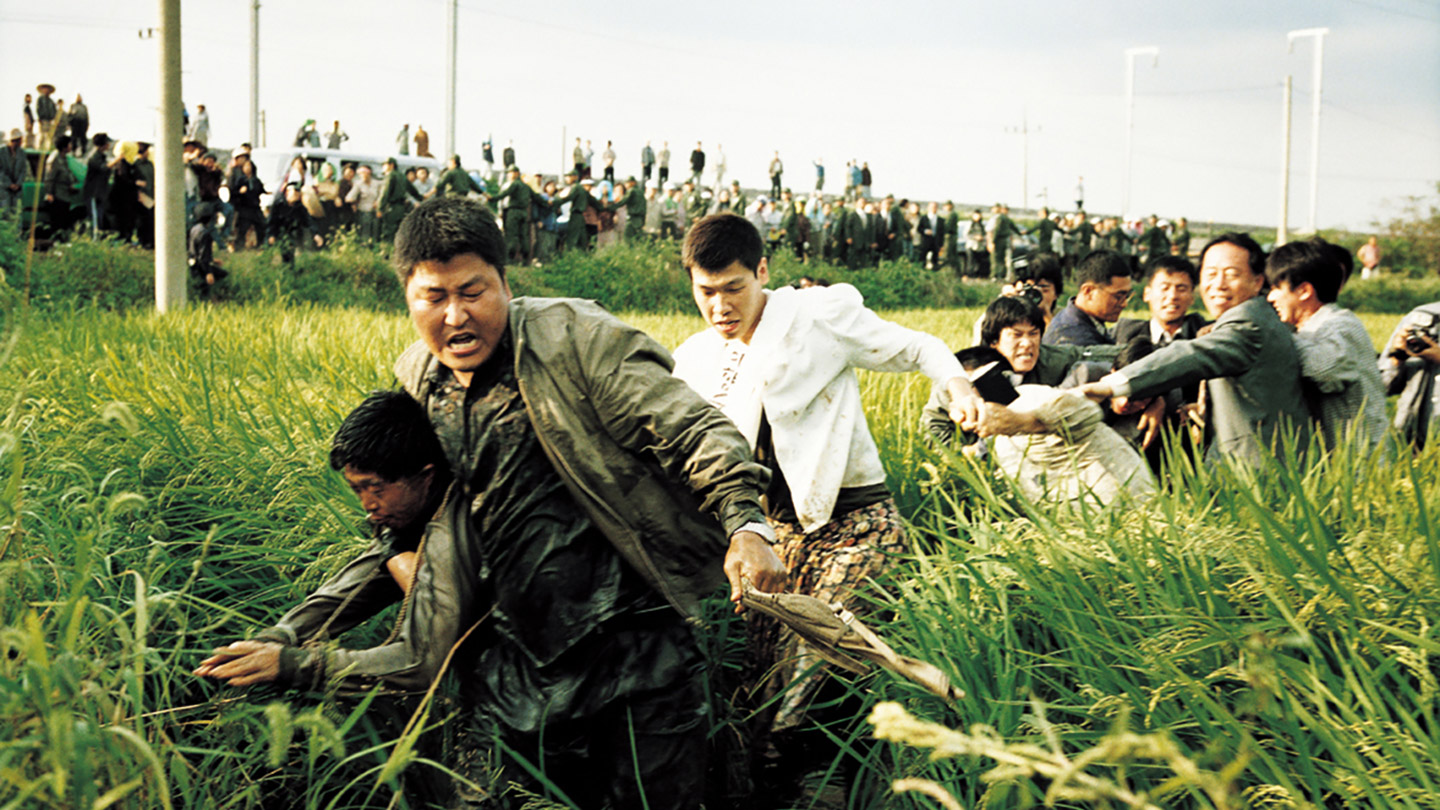
    On the gossip leaked by Kwak Seol-young, Park Doo-man grabs Baek Kwang-ho at a neighborhood arcade and interrogates him in a basement boiler room. As Kwang-ho rattles off the details of the killings, Park Doo-man takes it as a confession — when in fact Kwang-ho is testifying to what he witnessed firsthand (his mismatched answers, 'I didn't kill anyone,' 'How would I know?'). The reconstruction goes forward despite the mismatch in physical build, until it is exposed that his hand is paralyzed from burn complications, and Chief Koo is dismissed at the end of his term.

    Hyang-suk! Hyang-suk is pretty.

    Park Doo-man · Jo Yong-koo · Baek Kwang-ho · Koo Hee-bong

    Dig in →

  3. Yoo Jae-ha's 'Sad Letter' and the red-shirt trap

    Reviewing the case files, Seo Tae-yoon finds the pattern that the killings happen on rainy nights, and Kwon Kwi-ok reports that every one of those rainy nights had Yoo Jae-ha's 'Sad Letter' requested on the radio. Chief Shin Dong-cheol slaps the briefing-room desk and shouts, 'Rainy night… red clothes!' They dress Kwon Kwi-ok in red and set a trap, but what comes back the next morning is the body of another woman.

    Rainy night... red clothes!

    Seo Tae-yoon · Kwon Kwi-ok · Shin Dong-cheol

    Dig in →

  4. Jo Byung-soon's arrest and the alibi of the fifth murder

    Park Doo-man arrests Jo Byung-soon, a miner found masturbating at one of the killing sites. After all-night torture and beatings — including being hung upside down — they extract a false confession, but Seo Tae-yoon counters that the decisive 'soft hands' testimony does not match, and proposes they release him. While Park Doo-man fights him in a rage, a fifth murder occurs at the very hour Jo Byung-soon is in the interrogation room, and his innocence is proved.

    Park Doo-man · Seo Tae-yoon · Jo Byung-soon

    Dig in →

  5. Jo Yong-koo's leg, October 20, 1987

    At Baek Kwang-ho's family meat-grill restaurant, news of the Bucheon Police Station sexual-torture case plays on TV, and the college students at the next table start cursing the police. Jo Yong-koo tramples a female student with his boots, and in the brawl is impaled in the leg on the rusty nail of a plank Baek Kwang-ho swings in self-defense. The neglected wound becomes tetanus, and the date on the leg-amputation consent form Park Doo-man signs is October 20, 1987 — roughly a year after the first killing.

    Jo Yong-koo · Baek Kwang-ho · Park Doo-man

    Dig in →

  6. Kim So-hyun's death and the blackout drill

    The middle-school student Kim So-hyun — the one who, in a rainy checkpoint, had told the detectives the schoolhouse-restroom story — is raped and murdered on her late walk home through the woods. That night the government ran a civil-defense blackout drill — when the world is darkened, murder is at its easiest. On her body Seo Tae-yoon finds the bandage he had put on her back at the school infirmary, and covers her with his coat. The rage at Park Hyun-gyu begins immediately after.

    Seo Tae-yoon · Kim So-hyun

    Dig in →

  7. DNA before the tunnel and 'Are you eating proper meals?'

    Park Hyun-gyu has been caught, the semen sample has been sent to the FBI in the US — and the single sheet of paper that comes back says 'no match.' Seo Tae-yoon beats Park Hyun-gyu trying to force a confession, and the blood from his own hand soaks the very report. Park Doo-man steps in to stop the runaway Seo Tae-yoon. In the rain sprayed by a water cannon, he stares for a long time into Park Hyun-gyu's eyes and finally throws him the line, 'Fuck it, I don't know… are you eating proper meals?' and lets him go. Park Hyun-gyu disappears, handcuffed, into the darkness of the Jukbong Tunnel.

    Fuck it, I don't know... Are you eating proper meals?

    Park Doo-man · Seo Tae-yoon · Park Hyun-gyu

    Dig in →

  8. Seventeen years later, the paddy again (2003)

    Park Doo-man, now a juice-extractor salesman, makes a chance stop with his family at the paddy where the first case happened. A little girl approaches and says, 'A man came by just a few days ago, looking at this exact spot the same way.' Asked what he looked like, the girl answers — 'Just… kind of an ordinary face. Just… ordinary.' Park Doo-man lifts his head and stares directly into the camera (the audience). Bong Joon-ho has said that this look — deliberately violating a long-standing taboo of film direction — is aimed at 'the killer, who might be watching this film.'

    Just... kind of an ordinary face. Just... ordinary.

    Park Doo-man

    Dig in →

  9. The real killer caught outside the film (September 2019)

    On September 18, 2019, seventeen years after the film's release, the real killer of the Hwaseong serial murders was identified — Lee Choon-jae, who had been serving a life sentence in Busan Prison since 1994 for the murder of his sister-in-law in Cheongju. He had stayed off the suspect list because of a blood-type mismatch (actually Type O, analyzed at the time as Type B).

    Park Doo-man

    Dig in →

Chapter 3

Forks of Depth

4 central characters examined in their own dedicated essays.

Character study

Park Doo-man

protagonist

The origin and collapse of 'Shaman Eyes'

Park Doo-man claims that he can look at a suspect's face and know the killer. The story of how he picked out, from a crowd, a man who had been masturbating in the woods and run (he caught a glimpse of his red underwear) is the brag's foundation. But this 'ability' is no more than the eye for detail he has built up over years in a small village, and is helpless in front of unprecedented and grotesque killings. The brief shot where he misreads '12.16' as 'the 12th and the 16th' while briefing the new chief, or the scene where he cannot work a typewriter and the suspect has to show him how, both leak that his 'instinct' is in the end a mask covering an absence of education and system.

+ 3 more sections

Read the full dive →

Character study

Seo Tae-yoon

protagonist

Apostle of paperwork, man of the hand

Throughout the film Seo Tae-yoon is the character who, with his hands, leafs through documents and rifles through trash cans. His creed 'documents never lie' is not mere professional ethics but a metaphysical premise: 'evil can be recognized through external evidence.' Park Doo-man believes in 'interior insight,' Seo Tae-yoon in 'external evidence,' and so they are opposites — but as Lee Dong-jin points out, they share the common creed that 'evil can be recognized.' That is why they are both qualified to break in the same way.

+ 2 more sections

Read the full dive →

Character study

Park Hyun-gyu

antagonist

Soft hands and the MacGuffin of 'Sad Letter'

The circumstantial evidence pointing to Park Hyun-gyu is short and strong: the killings began right after his factory job started post-discharge; every rainy night a request for 'Sad Letter' on the radio; and a surviving victim's testimony of 'a soft white hand.' But More decisively, he cannot remember the content of his radio requests that were read on air — for him, the radio is everyday background music, on while he reads.

+ 2 more sections

Read the full dive →

Character study

Baek Kwang-ho

supporting

Hyang-suk, Hyang-suk is pretty — the mismatched register of a witness

Baek Kwang-ho's famous line 'Hyang-suk! Hyang-suk is pretty' was in fact a trace that he had been the actual eyewitness to the first killing. When Park Doo-man asked 'You killed all those women, didn't you?' he answered 'I didn't kill anyone,' and to 'Why did you kill her?' he said 'How would I know?' Park Doo-man heard it as a confession, but Baek Kwang-ho was speaking in the register of someone who had watched it from the side — he was hearing the question as 'What did he (that man) do to those women?' and could answer fluently for that reason. It was hidden only behind the developmental-disability tic of attaching '-da' (the declarative ending) in strange places.

+ 2 more sections

Read the full dive →

Appendix

Ripples and Threads

Production (8)

  • Based on Kim Kwang-rim's 1996 stage play Come See Me. Park Chan-wook had also tried for the rights, but Bong Joon-ho beat him to it by a hair.
  • Bong Joon-ho's second feature. Production budget 4.1 billion won (2.6 billion net + 1.5 billion marketing). Drew 5,255,376 admissions, the top-grossing Korean film of 2003, and held the box-office crown of the thriller genre for a decade (until Hide and Seek in 2013).
  • Cinematography by Kim Hyung-koo (who would stay with Bong through The Host). Production design by Yu Chung, Ryu Seong-hee, and Woo Je-hyung. Editing by Kim Sun-min. Score by the Japanese composer Iwashiro Taro. The inserted song Yoo Jae-ha's 'Sad Letter' was released in 1987, after the film's 1986 setting — a small period-detail error.
  • Byun Hee-bong fell over thirteen times during the two-minute opening paddy long take. The follow-up shot of a forensics officer also falling in the same spot is a calculated piece of direction.
  • After monitoring an early draft, Park Chan-wook suggested to Bong Joon-ho that the line on the scarecrow in the opening — 'turn yourself in or your limbs will rot and you'll die' — should be the title. Bong's reply: 'This film is important to me. Please don't.'
  • For Park Doo-man's stubby physical impression, Song Kang-ho put on 8 kg; for the late-film unraveling of Seo Tae-yoon, Kim Sang-kyung jogged every day and dropped 13 kg. On set, while Song Kang-ho ate himself stuffed, Kim Sang-kyung ate only enough to keep hunger at bay.
  • Park Doo-man's direct stare into the camera at the very end is a long-standing taboo of film direction. Bong Joon-ho deliberately told Song Kang-ho not to angle off even slightly, but to look full-on into the lens — the intent being to point the look at 'the killer who might be watching this film.'
  • 'Are you eating proper meals?' came out on the fourth take. In the cold of the water-cannon spray, Bong Joon-ho kept asking for another take without explaining why. Song Kang-ho, in his own words 'with his blood boiling away,' tried several lines and finally threw out this one. Only Bong Joon-ho liked it on set — and he slipped it in just before final cut.

Context (5)

  • Park Doo-man's real-life model is the late detective Ha Seung-kyun, who said after watching the film that 'I suffered the whole way through, because of scenes I had wanted not to remember.'
  • Park Hyun-gyu's real-life model is a Mr. Yoon who died of cancer in 1997 at the age of 27. Held for five days as a suspect in the 9th Hwaseong case, he was forced to write 27 false statements, was released after a DNA test result arrived from Japan, but was then held in solitary for three months on a charge of sexual assault — and died in 1997. His older brother Yoon Dong-gi was interviewed in the Seoul Shinmun in 2021.
  • Jo Yong-koo's leg amputation falls on October 20, 1987 — about a year after the reconstruction at the first crime scene. The TV news about the 1986 Bucheon Police Station sexual-torture case, playing inside Baek Kwang-ho's family meat-grill restaurant, is the direct trigger for Jo Yong-koo's eruption. ⟦OUTSIDE: Bong Joon-ho has said in interview that the amputation is 'a kind of revenge against the violent military regime and police of the time.'⟧
  • Lee Choon-jae had been serving a life sentence in Busan Prison since 1994 for the murder of his sister-in-law in Cheongju. In court testimony on November 2, 2020, he disclosed that he had watched Memories of Murder in prison. His impression: 'I felt nothing.'
  • Bong Joon-ho's interview after the 2019 arrest (Deadline): 'Does he look ordinary? Does he look like an ordinary man? I asked myself looking at his photo. You'll remember the very last line of the film. (…) I don't think real killers have ordinary faces. Somehow that comforted me.'

Interpretations & Debates

This film is not 'an investigation that fails to find the killer' but 'a great chronicle of defeat for every human capacity to recognize evil.'

Park Doo-man bets on the interior (instinct), Seo Tae-yoon on the exterior (paperwork); both collapse. Park Doo-man stares for a long time into Park Hyun-gyu's eyes and only mutters 'I don't know,' and Seo Tae-yoon sees the DNA report from the US he had trusted most soaked with the blood of his own hand. On top of them piles the defeat of state power as well — a state that, with a blackout drill, made the darkness in which the killings became easiest. To borrow Lee Dong-jin's phrase, the film ends in 'helplessness and lament in the face of evil.'

ⓘ Includes some external sources

Park Doo-man and Seo Tae-yoon start from opposite poles and slide toward each other's positions.

Park Doo-man begins as the country detective who wants to close the case fast with instinct, torture, and fabricated evidence, and Seo Tae-yoon as the elite who believes in paperwork and profiling. By the late film, however, Park Doo-man has gone cold and stands in the way of a runaway Seo Tae-yoon, and Seo Tae-yoon points a gun at Park Hyun-gyu. The two creeds have swapped positions through a single case — which reveals that the early joke (Park Doo-man flying-kicking Seo Tae-yoon on first meeting, mistaking him for a rapist) is in essence a variation that ends with both detectives occupying 'rapist' and 'victim's older brother' positions at once.

ⓘ Includes some external sources

The film's real victims are not only the women, but 'the four men of the system' — Baek Kwang-ho, Jo Byung-soon, Park Hyun-gyu, and Park Doo-man himself.

Baek Kwang-ho was easily framed and killed because of his developmental disability and burn scars. Jo Byung-soon was hung upside down and tortured under the 'pervert' label. Park Hyun-gyu was treated as an outsider for having soft hands and reading books. Even Park Doo-man, the ostensible perpetrator, is a victim of a backward investigation system — a state with riot police diverted to suppressing protests and without the genetic-testing equipment of its own. As Lim Jung-sik puts it, the victim-structure of the four men is different in form, but in cause they all touch the same barbaric power structure of the 1980s.

ⓘ Includes some external sources

Read more strongly, Park Doo-man himself is the symbol of the socio-political real killer of the Hwaseong case — the state power of the 1980s military regime.

The grasshopper boy in the opening wears the same clothes and hairstyle as Park Doo-man and mimics his words and gestures. The camera, after deliberately staging a mirror prop, equates the two. The shot after Baek Kwang-ho is hit by the train holds a close-up on Kwang-ho's blood on Park Doo-man's hand ('I finally got blood on my own hands'). The Bucheon Police Station sexual-torture case and the Hwaseong red-shirt killings both happened in 1986, and the syllable 'Doo' in Park Doo-man and 'Tae' in Seo Tae-yoon overlap with the names of the two presidents — Chun Doo-hwan and Roh Tae-woo, military-academy classmates. The final stare into the camera reads, inverted, not as the detective looking at the killer but as the killer looking out at the audience. ⟦OUTSIDE: This allegorical reading is a strong claim made on a Korean film blog (theqoo, '소름돋는해석'), and Bong Joon-ho has never publicly endorsed this schema in an official interview. He has, however, said: 'reading the details about the critique of the military regime, I realized one could think of it this way too.'⟧

ⓘ Includes some external sources
Credits

Screenplay
Bong Joon-ho · Shim Sung-bo
Music
Taro Iwashiro
Production
Sidus · CJ Entertainment
Original work
Kim Kwang-rim · Come to See Me