arrow_back
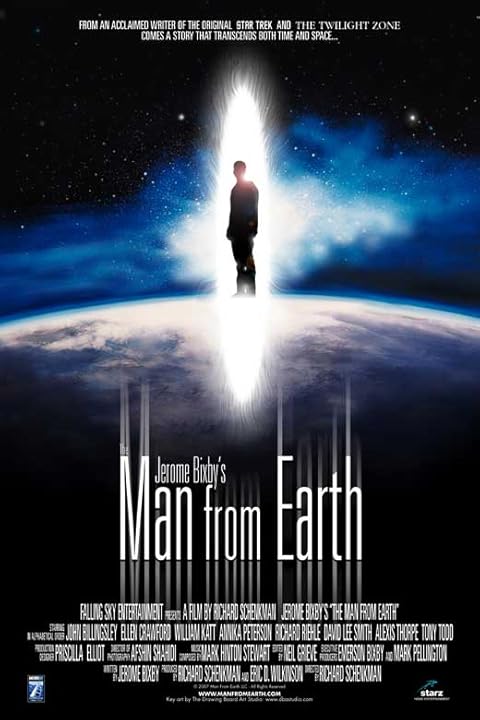
The Man from Earth
Special Pick
The Man from Earth

The Man from Earth

맨 프럼 어스

Directed by Richard Schenkman · 2007

History professor John Oldman, abruptly resigning a tenured chair and moving away, confesses at his farewell party that he is a 14,000-year-old Cro-Magnon who once tried to bring the Buddha's teachings West and accidentally became Jesus — and in one room the scholarly ground and religious faith of his seven colleagues come apart.

Chapter 1

Web of Characters

8 characters and 8 relationships that hold this story together.

Mini Map

John Oldman

protagonist

David Lee Smith

A late-Paleolithic Magdalenian-period Cro-Magnon. Around the age of 35 he realized he was not aging, and has lived as a drifting immortal — changing identity every ten years and slipping into a new community. With a mild, unaggressive nature he is loved by colleagues and students alike, but his sudden resignation, the Van Gogh in his trunk, and the Neolithic hand-axe in his living room raise his colleagues' suspicions.

Dig in →

Art Jenkins

antagonist

William Katt

A slightly pretentious figure who has published a book under his own name. Hearing John's story he treats him as having a mental problem and calls the psychiatrist Will Gruber to come and diagnose John's delusional disorder. His musical taste is the kind that would put on The Rite of Spring instead of Beethoven's 7th.

Dig in →

Dr. Will Gruber

antagonist

Richard Riehle

The most prominent and the oldest of the group. Emotionally fragile because his wife died of pancreatic cancer the day before the party, he comes at Art's request to counsel John. He pushes John toward a 'delusional disorder' diagnosis and even pulls a handgun (there were no bullets), but at the end, the moment John recognizes his childhood nickname 'Chilly Willy,' he realizes John is the father who abandoned him and dies of a heart attack.

Dig in →

Harry

supporting

John Billingsley

A consistently cheerful Jewish character. Married to a Muslim wife and raises his children free of religious constraint. He meets John's immortality hypothesis with academic curiosity and proposes that 'if cells regenerated completely, with no waste, no by-products, scars could be pushed off as new tissue grows in.'

Dig in →

Edith

supporting

Ellen Crawford

She has always been fond of John, but as his story unfolds her reaction turns sharply negative. The mention of the Sermon on the Mount shakes her with 'It can't be, can it?' and when John confesses that he had only tried to spread the Buddha's teachings and ended up turned into Jesus, she chokes back tears calling it blasphemy. In the final goodbye she is the only person in the film who kisses John.

Dig in →

Sandy

love_interest

Annika Peterson

Has worked at John's side for ten years and carries an unrequited love for him. The one person among them who, no matter what John says, does not waver but calmly takes his side. After Will's death, the person John stops and waits for instead of leaving alone is Sandy.

Dig in →

Linda Murphy

supporting

Alexis Thorpe

The youngest of the group, who comes along with Art. From context she is presumed to be in a relationship with Art. Her reaction is closer to believing John, all the way through.

Dig in →

Dan

supporting

Tony Todd

A rough-edged, generous figure. He mediates the colliding claims among the colleagues and listens to John's story most seriously of all. At the very start, finding a flint (a parrot-beak engraver) in John's living room, he steers the conversation onto the Paleolithic, and his mention of the Magdalenian culture leads John into his confession.

Dig in →

Chapter 2

Threads of Time

13 pivotal scenes that shaped this story, in order.

  1. Paleolithic realization — around 35 he realizes he is not aging

    Born somewhere in Europe, the Cro-Magnon John, at a physical age of about 35, comes to understand that he is not aging over time. His own people came to believe that he was absorbing the life force of others and eventually exiled him, and John begins the wandering pattern of leaving a community every ten years and entering another under a new identity. He watched the Lascaux cave paintings being made in real time, and remembers when the British isle was still attached to the continent by land.

    John Oldman

    Dig in →

  2. Voyage east — Phoenicia, Sumer, Hammurabi

    Believing, in the Ice Age, that east — where the sun rises — would be warmer, John simply heads east. He sailed the Mediterranean with the Phoenicians; in Mesopotamia he lived for several thousand years as a Sumerian and experienced the reign of Hammurabi firsthand. With the rise of civilization and centralized power, swapping identities grew harder and harder, and in 19th-century Belgium he served a year in prison for forging public documents.

    John Oldman

    Dig in →

  3. Meeting the Buddha — India

    Crossing the Hindu Kush into India, John meets Siddhartha Gautama and receives his teachings. John recalls the Buddha as 'the most extraordinary human being I ever met in all my years,' and that he 'seemed to see through to who I really was.' Here he learns the technique of dissolving pain and slowing his metabolism through meditation — a discipline that becomes the decisive tool for the fake death on the cross.

    John Oldman

    Dig in →

  4. Crucifixion and fake death — Roman-era Near East

    Repelled by the cruelty of the Roman Empire, John used the medicine he learned in India to heal the sick and spread Buddhist teachings, but the people of the time were not ready to receive them; marked as a dissident, he was crucified. With the meditation technique learned in India he killed the pain, lowered his breathing and pulse to a near-stop, and after being entombed in a cave for three days tried to slip away, only to be caught by his disciples. The agitated disciples refused to hear his denial of 'resurrection,' and he eventually fled back to Europe. From then on those who followed his teachings deified him, and the name, over time, deformed into 'Jesus.'

    John Oldman

    Dig in →

  5. Sailing with Columbus → friendship with Van Gogh → arrival in America in 1890

    Drifting through Europe John was at one point a feudal lord, and sailed west with Christopher Columbus (after thousands of years of experience he suspected the earth was not flat, though he confessed that at the moment of setting off he still feared falling off the edge). While living in France as a pig farmer named 'Jacques Bone,' he became friends with Vincent van Gogh and was personally given one of his paintings; after Van Gogh's death he crossed to America in 1890. That painting has been kept to the present day, and at the farewell party Edith — pointing out that it is 'in the Van Gogh style' — asks about its provenance.

    John Oldman · Edith

    Dig in →

  6. A meeting with a possible same-kind around 1600

    Around 1600 John met a man who appeared to be a being like himself. Comparing their experiences they thought there was a high probability the other was immortal, but neither could be certain. Two hundred years after parting, he caught a glimpse of him again at a train station in Brussels, only to lose him in the crowd. The identity of this possible same-kind is suspected to be , though the recorded life of the real Saint-Germain begins around 1710, leaving a time gap.

    John Oldman

    Dig in →

  7. Ten degrees since the 19th century — a progress one cannot keep up with

    Watching humanity's 19th-century scientific and technological progress, John drew on the knowledge he had built up to complete higher education. Over about 170 years he earned roughly ten degrees, but he reflects that the pace of advance in technology and knowledge was so fast he could not keep up with all of it. An important clue in the film that eternal time does not equal eternal cognitive power.

    John Oldman

    Dig in →

  8. The farewell party — the spark

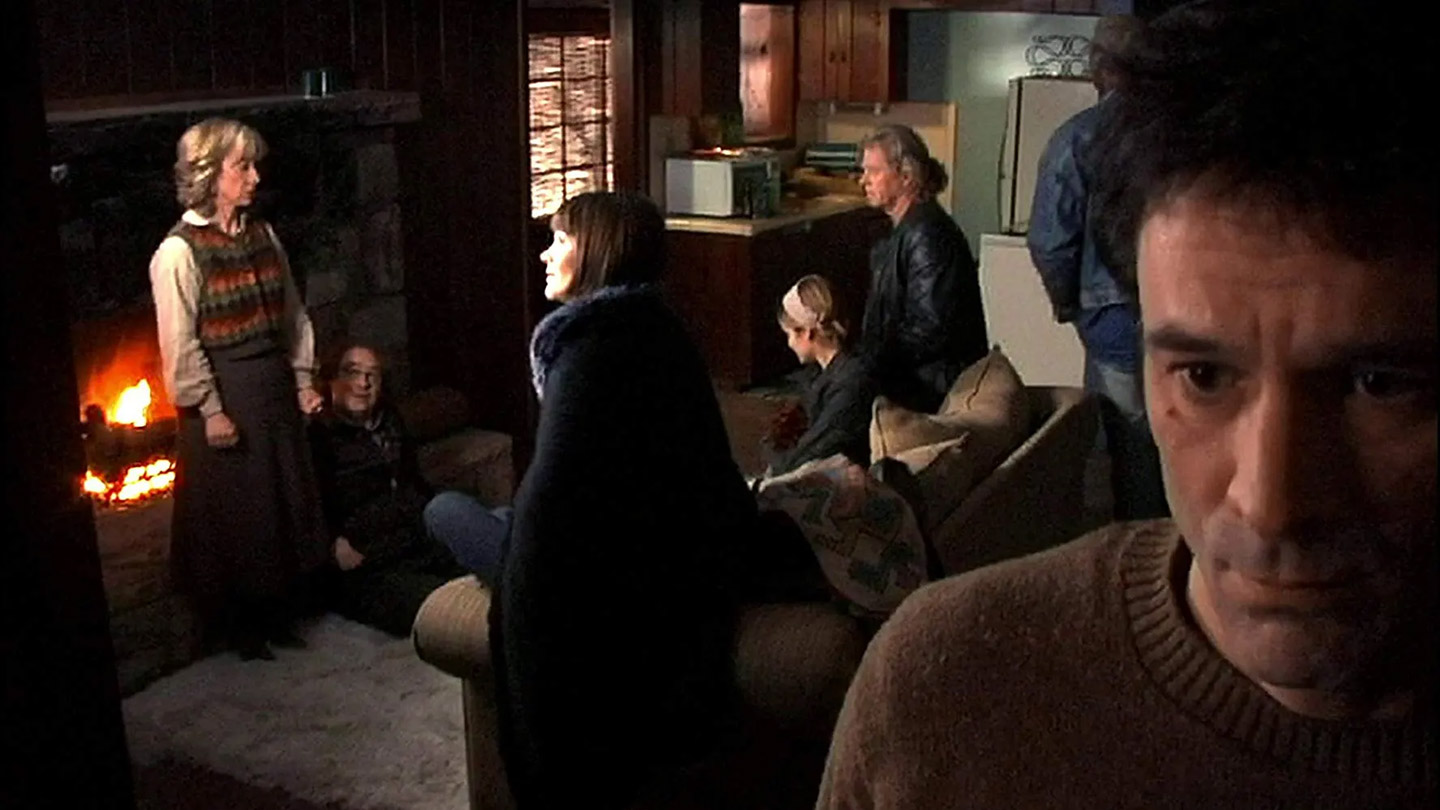
    Six colleague professors gather at John's remote country house to throw him a farewell party after he abruptly announces, in his tenth year of teaching, that he is retiring and moving away. The Van Gogh loaded in the trunk, the Neolithic hand-axe in a corner of the house, and a bottle of Johnnie Walker Green Label whet their curiosity. As the anthropologist Dan picks up a flint (a parrot-beak engraver), the conversation drifts naturally onto the late-Paleolithic Magdalenian period, and John begins to peel back his secret from the starting question, 'What would it be like if a Cro-Magnon were still alive?'

    John Oldman · Harry · Edith · Art Jenkins +3

    Dig in →

  9. Harry's cell-regeneration hypothesis — a moment of scholarly cooperation

    John says he is not even certain he is immortal — the only way to confirm it would be to actually die, which he has not been able to bring himself to try. Even so, he has caught fatal diseases like pneumonia, typhus, and the Black Death many times and survived, and has never once been left with a scar. To this the biology professor Harry offers an impromptu hypothesis.

    If cells regenerated completely, with no waste, no by-products

    John Oldman · Harry

    Dig in →

  10. Confession of Jesus — Edith breaks on the Sermon on the Mount

    To his colleagues' expectant questions, John confesses that in trying to bring the Buddha's teachings to the West he involuntarily became Jesus. Edith initially draws a firm line — John is not Jesus — but as John pours out an intimate knowledge of the Bible she begins to waver; when the Sermon on the Mount comes up, she is decisively shaken. John himself laments that all he had wanted was, in opposition to Roman cruelty, to spread a Buddhist teaching, but after he vanished the story was exaggerated and elaborated until in the end it became Jesus Christ.

    It can't be, can it?

    John Oldman · Edith

    Dig in →

  11. Will's pressure → John's 'it was a joke' retraction

    As the mood turns ugly, the psychiatrist Will heavily pressures John to tell everyone the whole thing was a prank — the rationale being that hearing the story is hurting them. As Will pushes, the close-ups of each colleague's face show them all visibly emptied out. With no telling where the room might go if he continues, John defuses the situation by saying everything so far was a lie, a piece of fiction inspired by all of them. Their reactions diverge — Edith is relieved, Harry stays open, Art says he never wants to see John again, and Will still believes John needs professional treatment.

    John Oldman · Dr. Will Gruber · Edith · Harry +1

    Dig in →

  12. Will's exposure and death — 'John T. Partee' and Chilly Willy

    After the others have all left, Sandy — who has been in love with John — asks him about the other names he has gone by. John says that sixty years earlier, while serving as a Harvard chemistry professor in Boston, he used the name 'John T. Partee,' a play on 'Boston Tea Party.' Will, on his way out the door, hears the name and his face hardens — he has realized that John was the father who vanished from his childhood. When John knows even the name of Will's mother and the dog Will kept as a child, Will collapses, recalling his mother's words. John soothes him with his childhood nickname 'Chilly Willy,' but Will, his pre-existing heart condition aggravated on top of having lost his wife the day before, dies on the spot. The fact that the new-name-every-ten-years pattern has held for at least sixty years removes any remaining doubt about John's immortality.

    Are you going to come to my funeral?

    John Oldman · Dr. Will Gruber · Sandy

    Dig in →

  13. Going with Sandy — the first companion

    Changing his plan to leave alone, John decides to depart together with Sandy, who loves him. For the first time in 14,000 years he meets a partner who, knowing what he is, has chosen to stay beside him. On the stage-play side, however, the ending differs — John refuses Sandy's reaching hand with 'No...' — exposing John's self-protective renunciation: if he loved Sandy and they had a child, that child too would be abandoned by its father and repeat the Will pattern.

    John Oldman · Sandy

    Dig in →

Chapter 3

Forks of Depth

4 central characters examined in their own dedicated essays.

Character study

John Oldman

protagonist

Identity swap every ten years — a technique for compressing time

Ever since he realized at 35 that he was not aging, John has lived by leaving a community every ten years, taking a new identity, and slipping into a different one. When humanity were still hunter-gatherers, identity-swap was easy, but as civilization and centralized power arose it grew harder and harder — in 19th-century Belgium he served a year in prison for forging public documents. At times he posed as his own son and re-entered an old community; at others, using the knowledge accumulated by living, he served as a shaman. Keeping the given name 'John' constant while swapping only surname and profession, this partial transformation is his methodology for compressing 14,000 years into a life that 'never loses self-identity yet is never tracked.'

+ 2 more sections

Read the full dive →

Character study

Dr. Will Gruber

antagonist

The attempt to diagnose as a psychiatrist — demotion to delusional disorder

Will is the most prominent and oldest member of the group, a psychiatrist who comes to counsel John at Art's request. He pushes John toward a 'delusional disorder' diagnosis and even pulls a handgun (later revealed to have no bullets) — but it is not merely a professional diagnosis. The line of questioning he keeps coming back to with John zeroes in on John's 'issues with a father' — Will diagnoses John's self-deification and grandiose-delusional behavior as the result of a problem with a father, but the ending exposes that the engine of that diagnosis was Will's own childhood trauma (being abandoned by his father).

+ 1 more sections

Read the full dive →

Character study

Sandy

love_interest

The only unresisting listener

Sandy has been John's assistant for ten years and carries a love for him. She is the one person in the room who, no matter what John says, does not waver, does not blanch, and quietly takes his side. When other professors press John from inside their own fields and try to refute him, Sandy does not treat John's story as a 'subject' to be proved but accepts it as his 'life.' The camera often holds her in solo shots, and her expression is not the expression of someone who doubts — she watches John's emotions rather than firing questions, and tries to shield him.

+ 1 more sections

Read the full dive →

Character study

Edith

supporting

Faith breaking on the Sermon on the Mount

Edith has been fond of John, but as his story begins her reaction turns sharply negative. She first draws a firm line that John is not Jesus, but as John pours out an intimate knowledge of the Bible she begins to waver, and when the Sermon on the Mount comes up she shows the deepest disturbance, saying 'It can't be, can it?' Her response is not anger but 'tears' — the primal fear a human being shows when the faith of a lifetime is denied.

+ 1 more sections

Read the full dive →

Appendix

Ripples and Threads

Context (4)

  • John has caught fatal diseases like pneumonia, typhus, and the Black Death many times and survived, and has never once been left with a scar. He himself is not even certain he is immortal; he says the only way to confirm it would be to actually die, and he has not been able to bring himself to try.
  • The technique of dissolving pain and slowing the metabolism, learned in India, becomes the decisive tool for the fake death on the cross. ⟦OUTSIDE: Long-practicing monks can in fact dissolve extreme pain and lower their breathing and pulse to an extreme degree; according to the British-born monk Ajahn Brahm's writing, his Thai teacher Ajahn Chah once dropped so low in breath and pulse during meditation that the people around him mistook him for dead and a commotion broke out.⟧
  • While humanity lived as hunter-gatherers, swapping identities was easy, but as civilization and centralized power arose it grew harder and harder. In 19th-century Belgium he was exposed for having changed identity and served a year in prison for forging public documents.
  • The 'Buddhist Jesus theory' (that Jesus received the Buddha's teachings in India) the film treats so weightily is in reality closer to a poorly supported piece of speculation — the proper way to take it is as a creator's imagination, in the manner of The Da Vinci Code.

Trivia (5)

  • While living in France as a pig farmer named Jacques Bone, John became friends with Vincent van Gogh and was personally given one of his paintings; that painting has been kept to the present day, and at the farewell party Edith — calling it 'in the Van Gogh style' — asks about its provenance.
  • In the West the name 'John' is also called by the nickname 'Jack,' in which case the French name 'Jacques' can be read as the French form of 'John.' A clue that for 14,000 years John has changed his surname but kept a name from the 'John' family consistently.
  • The identity of the kindred figure John met around 1600 appears to be ⟦OUTSIDE: Count Saint-Germain, the mystic figure who was called 'the man who does not age' in 18th-century European society⟧. There is a time gap with this — unlike the man met around 1600, the recorded life of the real Saint-Germain begins around 1710.
  • The whiskey in the film is Johnnie Walker Green Label — originally meant to be Blue Label, but apparently no Blue was on hand so Green was used instead. The founder of Johnnie Walker was named 'John,' matching the protagonist, and the brand slogan 'Keep walking' carries the meaning of never stopping — a winking clue that perhaps the founder, too, was John.
  • The second movement of Beethoven's Symphony No. 7 is used in the film and lends immersion and focus to the structure. When John puts it on, Art asks, 'Wouldn't The Rite of Spring be better?' — ⟦OUTSIDE: Stravinsky's The Rite of Spring is built on the material of a primal ritual and shows off raw, violent, eerie sound⟧, so the line is an interesting fit with the prehistoric backstory the protagonist has been recounting.

Production (3)

  • The film, for its 90 minutes, is built on nothing but the protagonist and his colleagues talking inside a house — and 'not even a single flashback of the protagonist recalling his own past' is shown. The 14,000 years are reproduced entirely through dialogue, without a single one of the usual flashbacks.
  • Screenwriter Jerome Bixby conceived the script in the early 1960s and dictated the last lines to his son Emerson Bixby on his deathbed in April 1998. Bixby wrote the Star Trek episode 'Requiem for Methuselah' (1969); this film is the final work of a master of immortality-themed SF.
  • Made on a roughly USD 200,000 budget, the film received no theatrical release in the US and went straight to DVD, but spread by word of mouth through torrents and other P2P networks. Producer Eric Wilkinson released a statement 'publicly thanking those who distributed the film via BitTorrent without permission,' and Schenkman even added a subtitle to the DVD thanking 'the people who promoted this film through illegal-download word-of-mouth.'

Interpretations & Debates

The core theme of this film is not the denial of Jesus, but 'how a myth gets made.'

John himself, in opposition to Roman cruelty, had only wanted to spread Buddhist teachings, but after he disappeared the story was exaggerated and built upon until it had become Jesus Christ — an allegory of the mechanism by which one ordinary human being's teaching, through the sedimentation of time, condenses into a sacred myth. Without denying the value of belief, the film says that belief too is just part of being human, and is, in the end, of humans and for humans.

The title 'The Man from Earth' is a de-mythologizing declaration that god/Jesus is not extraterrestrial or celestial but 'someone from Earth.'

The film's title 'Man from Earth' says that the protagonist too is, in the end, a human being who began from the Earth (Earth) or from the earth (earth) — that gods and Jesus are not extraterrestrial or celestial beings but ones that began on Earth, from Earth. Since at the end it is proven that he has not aged for at least fifty years, there is little room to read it as pure fabrication.

The essence of immortality is not power but solitude.

When one hears '14,000 years of life,' one tends to imagine wealth, antiquities, omniscience — but John has no rare objects, no expensive furniture. In a life where the meaning of a starting point has blurred, objects are things that will eventually vanish, and have no meaning. The closing scene in which Sandy leaves with him is not simple romance but the moment the 'complete solitude' he has carried for 14,000 years is dissolved — for the first time, he has met a partner who, knowing what he is, has chosen to stay beside him.

There is a suggestion that Sandy may be the same-kind John met in 1600.

Sandy alone among the colleagues, when the others press and contradict John, accepts him fully, and the camera often holds her in solo shots. She does not treat John's story as something to be 'proven' but accepts it as his 'life,' and rather than asking questions she watches his emotions and tries to protect him — at the very least, the one character with the empathic capacity to understand his solitude and his time. ⟦OUTSIDE: This reading is strongly argued in the ending-interpretation of the YouTube channel 'Dokdok-i,' and is not the canonical reading.⟧

ⓘ Includes some external sources

John's statements are logical, but to Edith they arrive as a violence that denies the meaning of her life.

The people who prided themselves on being intellectuals, on realizing that John's story has no logical defect, gradually slip into confusion — the primal fear a human being feels when the common sense and beliefs they have built over a lifetime are denied. John's words are logical, but to Edith they land as violence that denies the meaning of her life, and so she responds not in anger but in 'tears.'
Credits

Screenplay
제롬 빅스비
Music
마크 힌튼 스튜어트
Production
앵커 베이 엔터테인먼트 · 크래커픽쳐스