The Blurry Line Between Lie and Truth
The core theme of Big Fish explores the boundary between ‘truth’ and ‘story’ at the point where they dissolve. Though a son dismisses his father’s tales as boasting and tries to uncover the truth, the film ultimately shows that truth is not a bare recitation of objective facts but ‘story’ itself — reconstructed through love and memory. This process is the most beautiful way of completing the meaning of one person’s existence.
The Moment Lies Become Truth: The Power of Story
The film begins from the premise that all of father Edward Bloom’s adventure tales are ‘lies.’ From son Will Bloom’s perspective, the father’s stories are an endless succession of exaggeration and boasting. A house-sized giant, a destiny-seeing witch, a werewolf circus ringmaster — these are fantastical elements that defy the logic of reality. Will tries hard to judge his father’s life by the objective record of ‘fact,’ pushing these tales outside the domain of ‘truth.’
But as the film progresses, it becomes clear that these ‘lies’ were in fact the father’s real experiences filtered through and shaped into ‘story.’ The father is not merely lying — he is trying to reinterpret and complete his sense of self and meaning through the act of storytelling.
1. The Planting Moment: Doubt and Pursuit
Early in the film, Will is cynical every time he encounters his father’s stories. He dismisses his father’s life as ‘an exaggerated repertoire of a salesman’ and tries to find the real record of his father’s life. In this process Will uncovers evidence from within his father’s adventure tales, believing that ‘objective facts’ must exist in his father’s life. This belief itself becomes Will’s motivation for pursuing truth.
2. The Resolution Moment: The Completion of Story
As the father’s death approaches, Will meets the father’s old friends. This encounter fundamentally shakes Will’s perspective. Will realizes that his father’s stories were not complete lies — that the father had only dressed real people he met and things he experienced in the clothing of ‘story’ and given them new shape. The father completes his life as one grand narrative, trying to pass its meaning on to his son.
The most symbolic moment is when Will brings the story of the father’s water-connected death to closure. Will tells the father — with all the characters from his adventure tales gathered at a riverbank to welcome him — that the father’s body became a great fish and swam away, completing the father’s life as ‘story.’ At this moment, the lie is no longer boasting — it becomes the most beautiful truth of the life the father lived.
3. The Foreshadowing List: Narrative Devices That Wrap Truth
- The repetition of ‘Back in my day...’: This phrase is not merely a speech habit but a narrative device through which the father begins and closes his life as story. It endlessly reminds us that all adventure tales are contained within the frame of ‘story.’
- The evidence in the attic: Will’s act of finding evidence from within his father’s lies symbolizes the process of Will trying to find ‘fact.’ But these pieces of evidence ultimately become the material for ‘story.’
- The river and water motif: Throughout the film, the river serves as the backdrop for adventure and, ultimately, as ‘time’ and ‘the flow of life’ — in which everything flows and is completed. The father’s final image as a fish swimming down the river means that life naturally closes as story.
4. Why It Is the Core of the Work’s Identity
This structure proves that Big Fish is not merely a fantasy film but a philosophical exploration of ‘memory’ and ‘love.’ The father, by completing his life as story, proves that he existed. The film poses to audiences the question — ‘What is the real face of someone you love?’ — and delivers the message that truth exists not as objective evidence but as the meaning we assign through the power of story.
Why It Matters
The heart of this film lies in deconstructing the definition of ‘truth.’ What Will realizes through his father’s tales is that the value of life lies not in the recitation of facts but in how those facts are woven into meaningful stories. The father, by completing his life as one grand narrative, teaches his son ‘the way of telling stories.’ This gives the audience the deep resonance that we should not dismiss our life experiences as mere passing events but remember and love them as meaningful narratives elevated into story. This thematic consciousness earns Big Fish its reputation as a human existentialist drama — beyond simple fantasy.
Other 떡밥 dives3
- arrow_outward
The Fish Transformation at the River’s Edge
In the film’s climax, the scene where Ed Bloom compares his death to ‘becoming a great fish swimming down a river’ goes beyond a simple ending — it symbolically shows that his life was not a fixed set of facts but an endlessly flowing ‘narrative.’ This scene visualizes the moment the father completes his life as one grand story and passes it on to his son, at the very moment Will tries to bring ‘truth’ to bear.
- arrow_outward
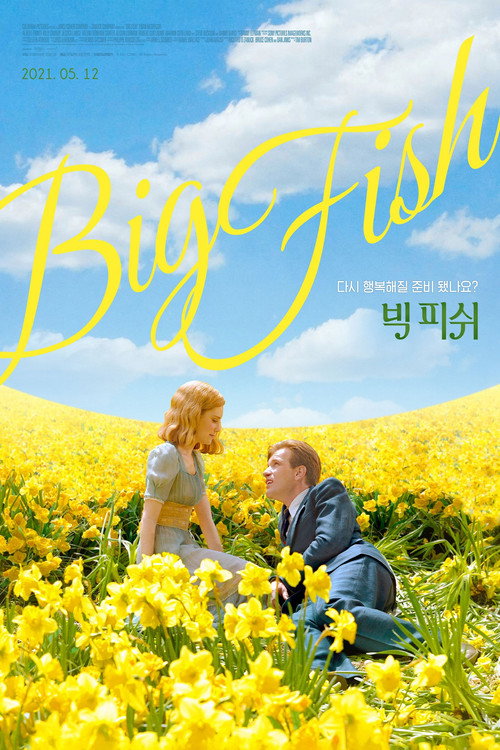
Tim Burton’s Uncharacteristically Warm Tone
Big Fish is characterized by a warm, dreamlike tone that departs from Tim Burton’s typical dark and macabre aesthetic, delivering emotional resonance to its audience. This tonal shift goes beyond a simple stylistic choice — it means that the method of dealing with ‘truth’ is expressed through the warm embrace of ‘storytelling’ rather than darkness or the grotesque, directly tied to the work’s core thematic consciousness.
- arrow_outward
The Ghost Town of Specter and the Witch
The ghost town of Specter and the witch Jenny are not mere fantastical backdrops — they are narrative devices through which Ed Bloom reconstructs his life as a ‘story.’ These spaces transcend the logic of reality, posing for the audience and son Will the fundamental questions of what ‘truth’ is, and whether what sustains a human life is objective fact or the power of beautiful fiction.
Back to the title
Big Fish
13 deep dives in total