arrow_back
The Green Mile
The Green Mile
Film

The Green Mile

The Green Mile

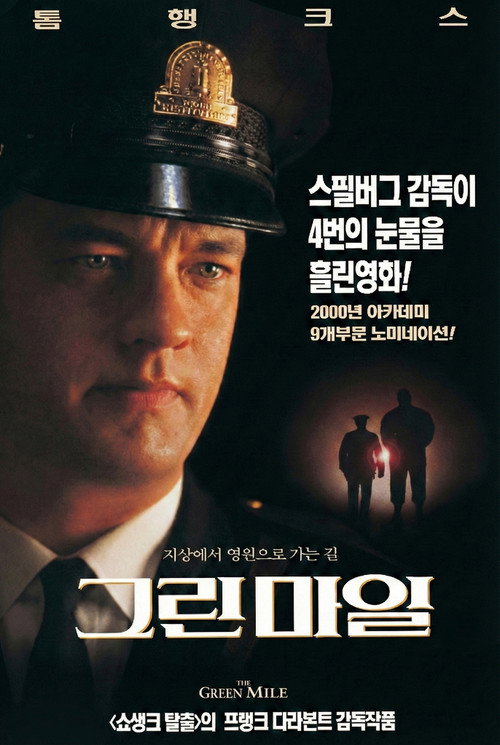
Directed by Frank Darabont · 1999-12-10 · 189 min · Castle Rock Entertainment

Louisiana's E Block, where condemned men await death. This is no ordinary prison—it is a space where the deep racial prejudice and moral guilt of 1930s America have crystallized. Paul Edgecomb, played by Tom Hanks, confronts professional limits he has long buried, along with guilt he has carried for sixty years. And there he meets John Coffey—a death-row inmate with a massive frame and a slow, gentle manner. He is no simple prisoner. The miraculous power he possesses is the warmest and most dangerous question ever cast into this absurd, brutal system. Can a miracle wash away sin—or does the miracle itself become an even greater sin?

Synopsis

In 1935, Paul Edgecomb, senior guard of Louisiana's E Block, manages death-row inmates while reflecting on his own life. He meets a newly arrived inmate named John Coffey and witnesses miraculous healing abilities from him. John's power first manifests by curing Paul's urinary infection, but Paul soon begins to question the case file that branded John a murderer. Paul and his colleagues work to prove John's innocence, yet the deep-rooted racial prejudice and systemic bias of the 1930s stand in their way. Ultimately John is executed, and Paul is left to endure agonizing conflict between his professional role and his human compassion for John. The story, set against a condemned man's final days, poses profound questions about justice and human dignity.

Cast6

P

Senior guard of E Block · Tom Hanks

A man haunted by old trauma and guilt. Encountering John Coffey and witnessing miracles, he endures a severe conflict between his professional role as a guard and his human conscience. His unnaturally long life becomes a source of guilt—punishment, he believes, for having killed a miracle.

J

Death-row inmate · Michael Clarke Duncan

A death-row inmate with an enormous frame and slow, gentle speech. Convicted for the alleged murders of sisters Cora and Kathe Dettrick, he is in fact innocent. He bestows a miraculous healing on Paul's urinary infection, then simultaneously reveals the goodness and despair of humanity.

B

Paul's subordinate guard · David Morse

Despite a nickname suggesting brutality, he is in fact gentle and sharp-humored. He plays a key role alongside Paul in doubting John Coffey's guilt, symbolizing the human bonds that persist even inside a prison.

J

Warden · James Cromwell

The warden of the prison. He initially insists on strict adherence to execution procedures, but after witnessing a miracle from John Coffey he gradually wavers emotionally, coming to feel the absurdity of the system.

E

E Block death-row inmate · Michael Jeter

A model inmate and Cajun-born death-row prisoner. He shows a gentle side caring for his mouse 'Mr. Jingles,' but the cruel treatment he endures during his execution symbolically exposes the inhumanity of the system.

J

Paul's wife · Bonnie Hunt

Paul Edgecomb's wife. Hearing the story of John Coffey from her husband, she instills in him a firm conviction that an innocent man must be saved. She is a pivotal figure who becomes the origin of the guilt Paul carries.

Credits

Screenplay
Frank Darabont
Music
Thomas Newman
Production
Castle Rock Entertainment · Darkwoods Productions
Chapter 02

Dig Deeper

Dig Deeper
Readingarrow_outward

Systemic Violence and the Absence of Justice

The Green Mile is not simply a work about a death-row inmate's tragedy — it is a profound critique of systemic violence set against 1930s Louisiana. The film places the full tragic weight of everything John Coffey suffers not in the question of whether he was actually guilty, but in the process itself by which he is branded because he is Black and executed by institutional prejudice. This poses a fundamental question about justice, arguing that the perfection of legal procedure does not automatically confer moral legitimacy.

Characterarrow_outward

John Coffey

John Coffey is a miraculous being cast into the brutal execution system of 1930s Louisiana. Behind his enormous frame and slow, gentle speech, his healing ability symbolizes the collision between human goodness and the absurdity of the system. He is not a simple prisoner — he is the warmest and most dangerous question about justice and human dignity itself.

Cardarrow_outward

The Origin of John Coffey's Miraculous Power

John Coffey's miraculous healing ability is interpreted not as a simple supernatural phenomenon but as a 'force of empathy' — the union of extreme despair and humanity's pure goodwill manifesting together. This ability, in the most cruel system of the execution chamber, poses the warmest and most dangerous question, making audiences ask about the origin of justice and human dignity.

Characterarrow_outward

Paul Edgecomb

Paul Edgecomb is haunted by past trauma and professional guilt, and through his encounter with death-row inmate John Coffey faces fundamental questions about his own life and justice. He endures severe conflict between the system's absurdity and human compassion, and comes to bear the heavy burden of lifelong guilt — the price of witnessing a miracle.

Cardarrow_outward

The True Culprit and the Revelation of Truth

The truth about the case that branded John Coffey a murderer shows that he is not simply a victim but a symbol of justice standing against the system's absurdity. The journey to prove John's innocence is a 'truth-tracking' voyage that transcends legal combat, and this truth is the most fragile and most important element that can only be discovered inside the closed and corrupt system that is the prison.

Characterarrow_outward

James Cromwell

James Cromwell — as warden — transcends a simple administrator's role; he symbolizes the conflict between the cruel execution system of 1930s Louisiana and the fundamental human conscience. He initially places discipline and procedure above all else, but after witnessing John Coffey's miracle he gradually struggles between the system's absurdity and human compassion, shouldering the weight between justice and mercy.

Characterarrow_outward

Jan Edgecomb

Jan Edgecomb, played by Bonnie Hunt, is not merely a wife — she is the moral conscience of protagonist Paul Edgecomb and the origin of his guilt. Through the existence of innocent John Coffey, she intensifies the conflict Paul experiences between professional duty and human compassion, acting as a catalyst that constantly poses questions to the audience about what justice means.

Cardarrow_outward

Racial Discrimination in 1930s Louisiana

The 1930s Louisiana prison that serves as the film's backdrop is not a simple jail — it is a space where deep racial discrimination against Black people and structural violence have crystallized. Everything John Coffey suffers is a symbol of the structural violence the system of that era inflicted on minorities, posing fundamental questions about justice and human dignity.

Readingarrow_outward

The Weight of the Miracle and the Burden of Sin

The core themes of The Green Mile — the weight of miracles and the burden of sin — explore how humanity's purest goodwill is rendered helpless before vast social systems and unjust legal judgment. The guilt of protagonist Paul Edgecomb stems not from the act of killing John Coffey itself, but from the anguish of having had to treat that miracle as merely 'part of the system,' trapped by professional helplessness and complicity. This work poses deep ethical questions about what justice means and how fragile human dignity is in the face of institutional prejudice.

Characterarrow_outward

Brutus 'Brutal' Howell

Brutus 'Brutal' Howell, contrary to his imposing nickname, is the figure representing the human conscience of E Block in Louisiana's prison. He plays a key role alongside Paul Edgecomb in doubting John Coffey's innocence, and even amid the system's absurdity never loses camaraderie and humor — symbolizing 'humanity' itself.

Cardarrow_outward

The Execution and Paul's Guilt

On the day of John Coffey's execution, the process in which Paul Edgecomb gives the signal for the electric charge is not simply a plot resolution — it dramatically reveals the collision between professional duty and human conscience. Paul undergoes the moment of becoming an 'accomplice' who kills a miracle, and is tormented by deep guilt about the system's absurdity and the nature of justice.

Quotearrow_outward

When I die and I stand before God and He asks me why I killed one of His true miracles, what am I gonna say? That it was my job?

Paul Edgecomb's line goes beyond a simple confession of guilt — it poses a fundamental question about professional duty and the divine. Placed in the situation of having to kill, in the name of 'the system,' the miracle of death-row inmate John Coffey, Paul confronts a moral dilemma that runs through his entire life. The line symbolizes the deepest anguish of the human soul when justice collides with systemic prejudice, and serves as the climax that maximizes the film's core theme of 'guilt.'

Characterarrow_outward

Eduard Delacroix

Eduard Delacroix is the model inmate of E Block in Louisiana's prison — a Cajun-born death-row prisoner who projects a gentle, docile image. Yet his character symbolically exposes the inhumanity of the system through the cruel treatment he endures during his execution. In particular, his method of execution — far beyond a simple execution — is a core device showing how personal grudges can trample on a human being's dignity.

Cardarrow_outward

Paul's Long Life and the Price of Sin

Paul Edgecomb's extreme longevity of 108 years is interpreted not as a simple flow of time but as a 'divine punishment' — a visualization of the eternal psychological burden he carries for having witnessed and then killing John Coffey's miracle. This longevity symbolizes the permanent psychological weight of guilt and the burden of salvation that form the film's core themes.

Quotearrow_outward

Tell God the Father it was a kindness done.

John Coffey's line — "Tell God the Father it was a kindness done" — spoken to Paul Edgecomb on the night before his execution, transcends simple comfort. It is a pivotal moment that collides the vast themes of professional duty and divine mercy. The line lifts the weight of guilt Paul must carry because of his professional role, and poses a fundamental question to the audience: what is justice, and how far must human guilt be held accountable?
Things worth knowing5

Racial Discrimination in 1930s Louisiana

The 1930s Louisiana prison that serves as the film's backdrop reflects an era saturated with deep-seated racial prejudice and bias against Black people. Every injustice John Coffey suffers is not merely personal guilt—it is a symbol of structural social violence.

The very fact that John Coffey was branded a murderer begins with him receiving the harshest possible verdict despite insufficient evidence, simply because he is Black. This is not just the tragedy of one individual—it is a metaphor for the structural violence and distrust that society inflicted on minorities at the time. Paul Edgecomb's anguish cannot be separated from this social guilt.

Foreshadowingarrow_outward
The Origin of John Coffey's Miraculous Power

John Coffey's healing ability is not simply a mysterious force. It is interpreted as a phenomenon born from the union of the suffering and despair he has endured with the pure goodwill of humanity. His power springs from a desperate longing to preserve life.

The process by which his power heals Paul's urinary infection shows that this force manifests under the extreme conditions of 'good intent' and 'desperate circumstances.' This ability emerges in its purest form in the most tragic of spaces—the execution chamber—and poses the fundamental question to the audience: 'Where does this power come from?'

Key Scenearrow_outward
The Execution and Paul's Guilt

On the day of John Coffey's execution, Paul is assigned the role of executioner who gives the signal for the electric charge. He struggles even to give the order or meet John's eyes, tormented by the guilt of having to kill a miracle with his own hands.

The scene in which Paul strains to hold back tears as he gives the execution order symbolizes the moment he becomes not merely a guard but a 'witness to sin' and an 'accomplice.' This scene dramatically reveals the collision between professional duty and human conscience, forming the film's greatest emotional climax.

Paul's Long Life and the Price of Sin

Having absorbed part of John Coffey's power, Paul Edgecomb lives to 108. He believes that surviving so long is a kind of 'divine punishment' for having killed the miracle of an innocent man, and he is consumed by deep unease.

The detail of Paul's extreme longevity visualizes the weight of the sin he must carry. He is denied even the natural release of death, condemned to suffer in the guilt of the survivor. This symbolizes the eternal psychological burden borne by 'one who has witnessed a miracle.'

Foreshadowingarrow_outward
The True Culprit and the Revelation of Truth

The real murderer in the case that branded John Coffey a killer exists elsewhere. This truth becomes the decisive catalyst that makes Paul doubt John's guilt and overturns every suspicion held within the prison.

The process of proving John's innocence is a journey of 'truth-tracking' that transcends a mere legal battle. This truth can only be discovered inside the closed, corrupt system that is the prison—the most fragile and most important element in the entire story.

Memorable lines2

When I die and I stand before God and He asks me why I killed one of His true miracles, what am I gonna say? That it was my job?

Paul Edgecomb · Paul confesses his professional role and guilt on the eve of John Coffey's execution.

Tell God the Father it was a kindness done.

John Coffey · After Paul pours out his guilt, John comforts him with this reply.
Chapter 03

Aftermath

Aftermath

Legacy

The Green Mile is praised as a masterwork carrying a socially critical message far beyond a simple prison thriller, broadening the horizons of genre cinema. In particular, while addressing the heavy themes of racial discrimination and structural violence, it never loses the universal sensibility of miracles and human love, leaving a deep impression on a wide audience. Since its release, it has become an important reference for works dealing with 'the absurdity of the system.'

Trivia2