Quotearrow_outward
You're stupid, Verbal. Stupid and crippled.
"You're stupid, Verbal. Stupid and crippled." Far from a mere insult, this line from Detective Dave Kujan is the psychological weapon that collapses every truth in The Usual Suspects. It symbolises the decisive moment when Kujan simultaneously attacks the two weaknesses he believed Verbal possessed — intellectual and physical — stripping away Verbal's mask in the process.
Cardarrow_outward
The meaning and origin of Keyser Söze
The police station office in The Usual Suspects is not merely a backdrop — it is the stage and instrument of fabrication on which Verbal Kint meticulously assembled the great lie to conceal his identity. By treating surrounding objects, bulletin board notices, and the manufacturer name on a cup as if they were truth, Verbal draws the gaze of the audience and Detective Kujan inside the testimony rather than outside the events.
Characterarrow_outward
Michael McManus
Roger 'Verbal' Kint appears not merely as a survivor of events — he is the incarnation of the film's greatest fabrication, the living embodiment of 'the relativity of truth.' His testimony is not a reconstruction of memory but a false narrative assembled from environmental elements, and it is the film's core device for toppling every truth the audience believed.
Characterarrow_outward
Character
Michael McManus is a professional thief — the most skilled and proactive criminal in the group. His expertise drives the group's technical operations, but he ultimately becomes a sacrificial victim of the vast conspiracy, embodying the tragic conclusion that no matter how skilled a criminal, they cannot resist the force of fate and the system.
Characterarrow_outward
Character
Todd Hockney is one of the five suspects in The Usual Suspects — a competitive heist man whose setting breeds a tension-filled rivalry with Michael McManus inside the group. He is shot and killed moments after discovering a stash of cash during the climactic drug-deal operation. His existence demonstrates the group's inherent instability, and confirms that they were ultimately nothing more than pawns sacrificed inside a vast conspiracy.
Characterarrow_outward
Character
Fred Fenster is one of the five suspects in The Usual Suspects — a figure characterised by an idiosyncratic manner of speech and an unstable psychological state. Rather than a typical group criminal, he symbolises the tragic, peripheral element of events and, within the film's complex plot, fulfils the role of victim.
Cardarrow_outward
The structure and backdrop of the incident
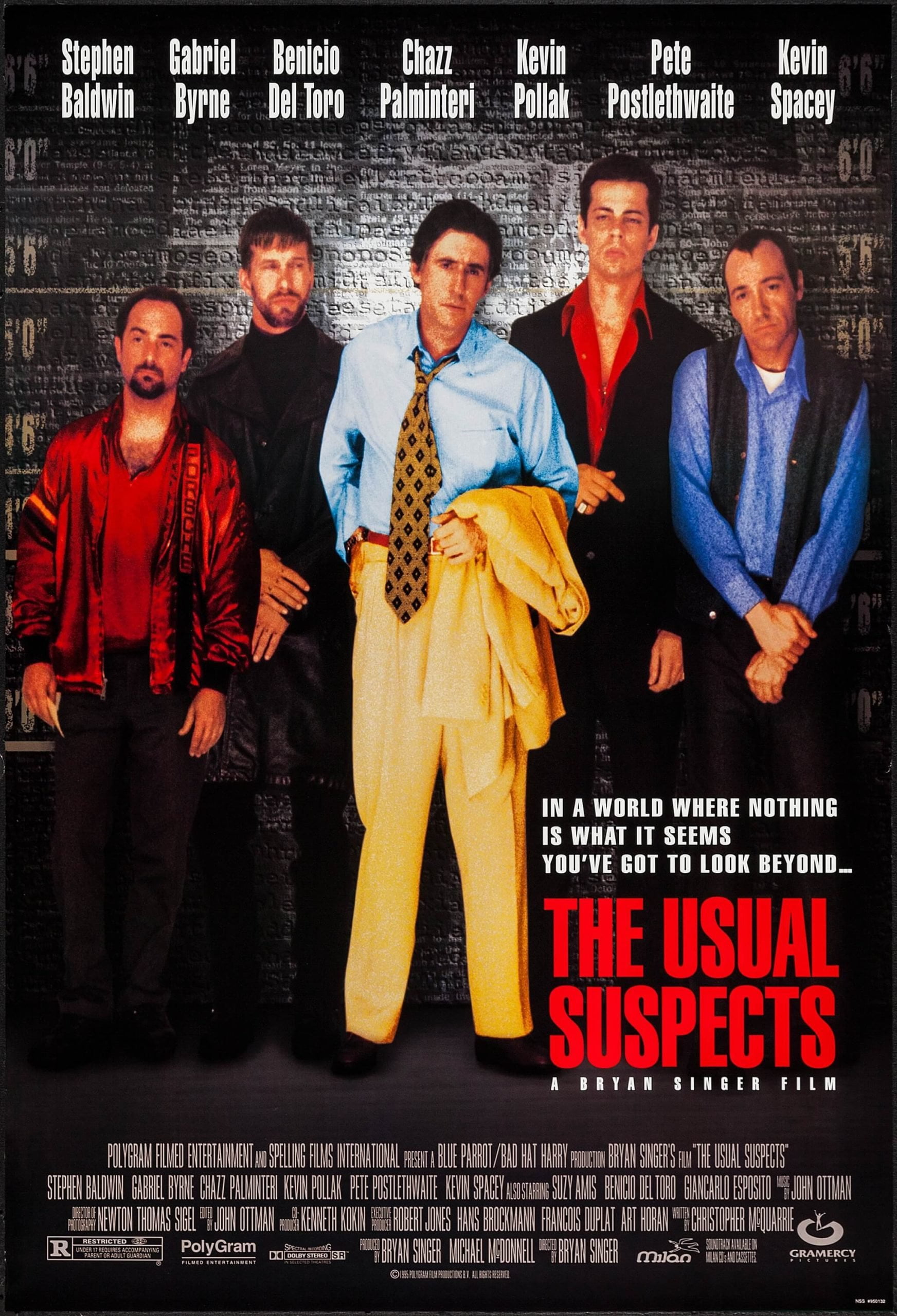
At its core, The Usual Suspects is not a simple crime thriller but a structural masterpiece that dismantles the very concept of 'truth.' The film revolves around the explosion at San Pedro harbor, reconstructing events through the testimony of the sole survivor, Verbal Kint. In doing so, the audience is confronted with philosophical questions about the reliability of testimony, the value of objective evidence, and the inherent corruptibility of memory.
Characterarrow_outward
Character
Edie Finneran is more than a love interest — she is the psychological vulnerability of ex-cop-turned-criminal Dean Keaton and the device that ignites the film's core conflict. Her presence functions as a 'moral anchor' that makes Keaton hesitate to fully enter the criminal world, and is ultimately weaponised against him by Keyser Söze with devastating efficiency.
Readingarrow_outward
The Relativity of Truth and Fiction
The Usual Suspects argues that objective truth does not exist — that truth is nothing more than a 'story' packaged most persuasively. The film follows the testimony of sole survivor Verbal Kint and exposes that every event and every character the audience believed in was a vast fabricated structure, assembled with meticulous precision.
Readingarrow_outward
Narrative Control and Fate
Roger 'Verbal' Kint is not merely a witness — he is a survival specialist who disguises his identity with extraordinary precision. By voluntarily inhabiting the weaknesses of a cripple and a fool, he becomes the last person anyone suspects. This manufactured identity is his most powerful weapon: it allows him to grasp the truth of events, protect himself, and deceive every detective and audience member alike.
Cardarrow_outward
Doubting the veracity of events
Keyser Söze is not simply a villain's name — he is the legendary embodiment of 'deception' that threads through the entire film. His mysterious history and the film's iconic line — 'The greatest trick the Devil ever pulled was convincing the world he didn't exist' — hold the core theme that makes the audience realize every truth it believed was erected on a vast fabrication.
Characterarrow_outward
Character
Dean Keaton is a former police officer turned criminal and one of the film's chief suspects — but he is in fact Keyser Söze himself, the legendary crime lord who orchestrated every event. His existence is not merely that of a criminal: it functions as the device that erects the entire edifice of false truth the audience had come to believe.
Quotearrow_outward
Quote
"Looking at it now I guess it does, but look at it from far away." This is the sentence that completes every reversal in The Usual Suspects. It functions not as the end of a testimony but as a meta-level device that makes the audience question every narrative structure it trusted, elevating the film from a crime thriller to a philosophical inquiry into the reconstruction of truth.
Characterarrow_outward
Roger 'Verbal' Kint
Dave Kujan is the customs agent pursuing the truth — the character who represents the audience's own perspective. He listens to Verbal's testimony throughout and attempts deduction, and in the final moments realises that everything he believed was built on a vast lie. His point of view vicariously performs the audience's process of reasoning toward truth.
Cardarrow_outward
Verbal's final walk out of the station
The climax of The Usual Suspects — Verbal Kint's final walk out of the station — is not a mere exit but a visual device showing the return from a perfectly performed 'false self' to the 'true controller.' The gradual straightening of the dragging leg into a confident stride is the most symbolically charged shot in the film and completes the reversal at its highest pitch.
Quotearrow_outward
The greatest trick the Devil ever pulled was convincing the world he didn't exist.
The line Roger 'Verbal' Kint leaves behind is the film's thematic core in a single sentence. It goes far beyond the ending of a crime thriller to pose a philosophical question: how fragile and malleable is the concept of 'truth' as humans perceive it? Announcing that every scene and every testimony the audience witnessed was an enormous performance, it is the key device that pushes the film beyond its genre boundaries.
Cardarrow_outward
The film's twist structure and its cultural legacy
The Usual Suspects is not a simple chase thriller but a structural masterwork that dismantles the concept of 'truth.' The film's core lies not in knowing the identity of the criminal but in the process by which the audience arrives at that knowledge. Every testimony and plot development rests on a meticulously constructed lie, posing to the audience the foundational question 'what do I choose to believe?' and establishing a new benchmark for the genre twist.